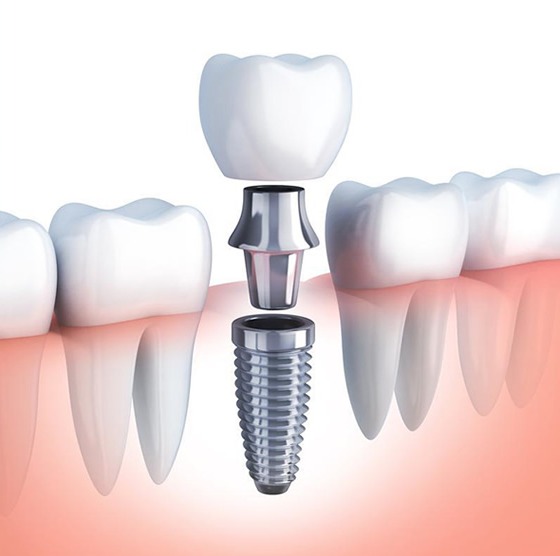

What is Izmir Dental Implant Treatment?Dental implant treatment; is a dental restoration process consisting of biocompatible titanium screws (artificial roots) placed into the jawbone to restore the function and aesthetics of lost natural teeth, along with added prosthetics.
In human anatomy, teeth transmit chewing forces to the bone through their roots anchored to the jawbone. When a tooth is lost, not only is the visible crown part eliminated, but also the vital root support inside the bone disappears. The science of implantology aims to eliminate this biological deficiency by using artificial roots made from high biocompatibility materials like titanium or zirconium. This method, applied directly to the area of deficiency without requiring the neighboring natural teeth on either side to be reduced, helps control bone resorption due to the chewing pressure transmitted internally to the bone.
In the Avrupadent clinics located in Izmir, dental implant procedures are approached with a multidisciplinary methodology. In this field, where principles of jaw surgery are combined with aesthetic prosthesis design, the patient’s facial proportions, jaw joint balance, and existing bone volume are evaluated in detail. The primary goal of the medical procedures performed is to restore the person’s missing digestive (chewing) and speech (phonetic) functions with structures that show cellular compatibility with oral tissues over the long term.
When is Dental Implant Treatment Applied in Izmir?
There are many alternatives to replace missing tissues in dentistry. However, in cases where traditional methods create anatomical limitations, artificial root applications come to the fore. The gaps that occur in the oral structure cause the positions of other teeth to shift over time. The fundamental situations planned to overcome this biomechanical imbalance are as follows:
| Clinical Condition | Functional Impact of the Procedure |
|---|---|
| Single Tooth Losses | Independent coating is applied over a titanium root placed in the relevant gap without carving the surrounding teeth, preserving the tissues. |
| Back Area Deficiencies | In scenarios where there are no supporting molar teeth at the back of the jaw, moving ahead with the use of hook prostheses. |
| Wide Gap Losses | Supporting bridges when existing natural teeth cannot bear the load of the bridge in long-distance gaps. |
| Complete Dental Loss | In patients who do not want to use a denture, ensuring a fixed or locked removable dental arrangement with artificial roots positioned in the jaw. |
How is Dental Implant Treatment Planned in Izmir?
At İzmir Avrupadent, the treatment process is shaped correctly from the prosthetic phase to the surgical phase. The physician first designs the shape of the porcelain or zirconium tooth that will be in the patient’s mouth at the final stage, the axis of chewing, and the lip support. The angle of the titanium body to be placed inside the jawbone is determined according to the mechanical requirements of the future tooth. This design provides a solid foundation for the restoration to function without problems in the future.
During the planning phase, digital systems are heavily utilized. The patient’s bone density is examined on the computer screen, the diameter and length of the artificial root to be used are selected from a digital archive and integrated into the bone in a virtual environment. Safety distances to the nerve channels (mandibular canal) extending in the lower jaw and the sinus cavities in the upper jaw are calculated, clarifying the route that will be followed step by step during the operation.
Who Can Benefit from Dental Implant Treatment?
There is no upper age limit for translating this application into clinical practice; procedures can even be performed on individuals in their nineties, as long as the bone quality permits. The important criterion is the individual’s overall medical status. In children and adolescents whose bone development is ongoing, it is recommended to stop jaw growth so that the titanium root placed for support does not create positional asymmetry in the following years.
In individuals with chronic diseases such as diabetes, hypertension, or osteoporosis, it is advised to share information with the patient’s own physician to monitor clinical values. When medical findings reach stable levels, surgical steps can be safely planned.
How Is an Evaluation Conducted Before Dental Implant Treatment?
Placing an artificial root into the tissue depends on cellular repair capability. If there is untreated severe gum inflammation (periodontitis) in the mouth, bacteria in that area can spread to the newly placed artificial root, compromising its stability. Doctors perform preliminary supportive treatments, such as professional dental cleaning, to achieve optimal oral hygiene before proceeding with surgical intervention.
The medications used by the hospital affect the treatment plan. The use of anticoagulant agents or bisphosphonate medications that affect bone metabolism must be communicated in detail to the physician. During the assessment, the vertical closure dimension (the distance between the jaws) is measured, confirming whether there is sufficient space for the anatomical height of the tooth to be placed on the implant.
Which diagnostic and imaging methods are used in dental implant treatment?
For the physician to take proactive steps during surgery, it is essential to employ specific radiological devices that elucidate the hidden anatomy beneath the tissue. The data provided by imaging techniques are the sole guides that increase the clinical success rate:
-
\t
- Panoramic Radiography: This is the first referral technique that shows the openings of the tooth roots, existing infection areas, and the basic bone structure in two dimensions (wide view).
- Dental Volumetric Tomography (CBCT): This advanced equipment models the bone width that cannot be detected in two-dimensional films, the exact position of the mandibular nerve canal, and the sagging rate of the sinus cavities in millimetric sections.
- Intraoral Optical Scanners: These are camera-based systems that digitally replicate the topography of the jaws and gums, allowing for the precise production of surgical guide plates (guides).
\t
\t
How is the Dental Implant Treatment Process Progressed?
The operation is usually performed under local anesthesia. Titanium bodies are positioned in the millimetric guide slots opened in the jawbone. At the end of the procedure, the tissues are closed with small stitches, and the individual enters the cellular healing phase. The retention and integration of the artificial root to the jawbone requires a biological waiting period of about 2 to 3 months in the lower jaw and an average of 3 to 6 months in the upper jaw (due to the more porous structure of the bone).
Once the integration period is completed, the construction of the main prosthesis begins. The doctor removes the temporary caps on the gums, places the measurement transfer pieces, and sends a copy of these dimensions to the laboratory. The dental upper structures prepared in the laboratory (crowns or bridges) are fixed to the titanium roots following the bite trials conducted in the clinical setting.
What Stages Are Followed in Dental Implant Treatment?
The clinic has a meticulous sequence where surgical and laboratory processes follow one another. The implantology processes consist of the following standard steps:
| Application Stage | Medical Details of Procedure |
|---|---|
| Surgical Placement | Preparation of the bone socket in the anesthetized area and positioning the titanium root at the specified depth. |
| Osteointegration | Months spent waiting for the bone to cellularly adhere to the titanium surface, depending on the patient’s condition. |
| Gum Shaping | Shaping of the mucosa (gum) socket where the porcelain head is placed on the integrated body. |
| Measurement and Prosthesis Delivery | Functional testing and stabilization of dental prostheses produced with digital or manual copies in the mouth. |
What Should Be Considered Before Dental Implant Treatment?
Keeping the bacterial load in the work area at a minimum level is crucial to prevent possible complications when a surgical procedure is to be performed. If the doctor prescribes a medication (prophylactic antibiotic or a special mouthwash) to be started before the procedure, using it according to the specified schedule is of great importance for the success of the clinical procedure.
Since local anesthesia will be provided, the patient’s clinical comfort during the operation should be maintained; therefore, participating in the appointment in a relaxed manner, away from intense stress and anxiety, supports heart rhythm and blood pressure balance positively. Regarding the use of medications that affect blood clotting, the doctor’s directives should be followed strictly.
What Should Be Considered After Dental Implant Treatment?
After the surgical effect on the tissues, mild swelling in the cheeks and minimal leakage in the operation area is a normal response of cellular repair. Applying ice compress (intermittently) within the first 24 hours will prevent the expansion of this swelling. Care should be taken to avoid drinking liquids with a straw or constantly rinsing the mouth as pressure and suction can displace the blood clot.
The substances in cigarette smoke reduce the amount of oxygen reaching the capillaries, which can hinder the integration of the titanium surface with the bone. For the long-term success of the treatment, it is strongly recommended to limit smoking, especially in the initial healing weeks. Pain relief can be comfortably managed with analgesic medication deemed appropriate by your physician.
How is Implant Treatment Planned for Single Tooth Loss?
In the past years, single tooth loss was typically compensated by reducing the two adjacent healthy teeth and making a three-unit porcelain bridge. However, current tissue-preserving approaches do not consider it appropriate to damage the enamel of healthy teeth. With the application of an artificial root, the missing area is treated locally, isolating the adjacent teeth entirely from the process.
Especially in the anterior area (aesthetic region) losses, the angle of the titanium body to be placed should mimic the emergence profile of the natural gum. With the use of a zirconium abutment attached to the relevant area, gray reflection from within the gum is prevented, allowing for high translucency and creating a structure indistinguishable from the other teeth.
How is Implant Treatment Evaluated for Multiple Tooth Loss?
In the processes of Izmir Avrupadent, engineering principles are blended with biology. If there are 3 or 4 adjacent tooth gaps in the jaw, placing a separate screw for each missing tooth can reduce blood flow in the bone and can complicate aesthetic outcomes. Instead, two artificial roots are placed at the corner points of the created gap (for instance, at the beginning and end).
These two solid roots are connected with a durable zirconium or porcelain bridge that carries the teeth in the middle. Thus, unnecessary surgical interventions are avoided while the chewing system is restructured with sufficient mechanical resistance. In order not to be condemned to free-end removable prostheses when the molar teeth are lost in the back areas, these bridge systems are quite an effective solution.
How Can Implant Treatment Be Planned in Cases of Complete Tooth Loss?
For individuals experiencing total tooth loss, traditional complete dentures can particularly show instability during speaking and eating on the lower jaw. By placing 2 or 4 artificial roots into the jawbone, special retention mechanisms are added to these movable dentures; thus, the movement of the prosthesis in the mouth is prevented, achieving semi-stable comfort.
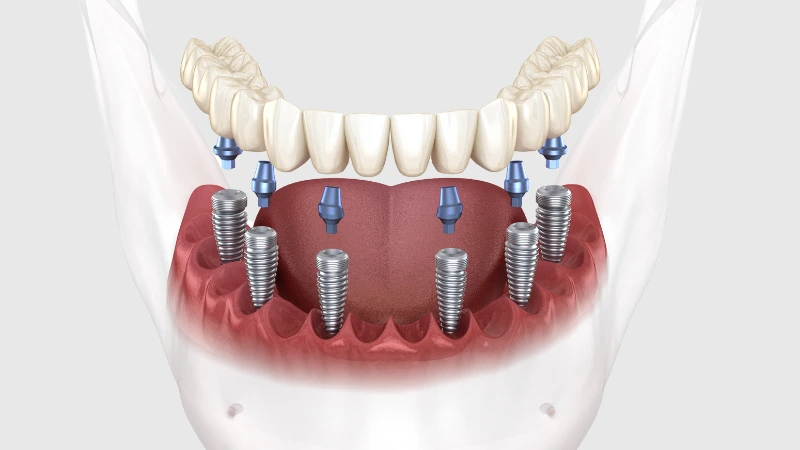
For patients who do not want to use removable prostheses at all, the “All-on-4” or “All-on-6” concepts are also considered. In these techniques, 4 or 6 screws are positioned strategically into the jaw, and non-removable (fixed) porcelain restorations covering the entire jawline are screwed onto these screws, allowing for the direct transmission of chewing forces to the bone, which slows down resorption and brings functional capacity very close to that of natural teeth.
How is the Jawbone Evaluated in Implant Treatment?
The stabilization of an artificial root inside the bone depends on the presence of at least one millimeter of healthy bone tissue around it. In regions left vacant for many years after a tooth extraction, physiological bone resorption is observed. The physician analyzes whether the bone can support the volume based on comparing the diameter of the screw planned for placement with the thickness of the existing jaw crest (the top of the bone).
Additionally, the vertical distance to the mandibular nerve canal extending in the lower jaw and the sinus cavities located behind the cheek in the upper jaw are measured to identify safe working areas. Bone density also determines the surgical process; in hard bones, the artificial root holds very tightly at the moment of placement, while in soft bones, prolonging the bonding phase is considered clinically appropriate.
In which situations can bone grafting and sinus lifting procedures be evaluated?
When the back (molar) teeth of the upper jaw are lost, the anatomical air cavities (maxillary sinuses) located just above that area sag downwards and may leave the jawbone with a paper-thin texture. A titanium screw cannot be placed in this thin bone. The procedure called “sinus lifting” gently pushes the membrane of the sinus upwards and fills it with bone powder (graft) to create a new bone depth.
In the regions where both the upper and lower jaws exhibit horizontal thinning (the jaw tip), directed bone regeneration techniques are applied. Animal, synthetic, or human-derived biocompatible bone powders are placed in the melted area and covered with special membranes (barriers). Within a few months, the body transforms these powders into its living bone tissue, preparing the necessary groundwork for the application of artificial roots.
How are Implant Overdentures Planned?
The prosthesis phase is an aesthetic process as delicate as surgery. Utilizing gum shapers, a curved socket is created to ensure that the mucosa appears as if the porcelain tooth has naturally emerged from the bone. Once this socket is formed, the directional and depth data of the roots are transferred to the laboratory using digital cameras or elastic measuring materials.
The connecting pieces known as abutments are designed according to the area where the tooth is located; zirconium abutments are often preferred to prevent gray reflections in aesthetic regions. After the prepared crown or bridge structure is trialed in the mouth, the occlusion adjustments are finalized either by bonding them with special resin cements or by directly securing them to the body with tiny screws, according to the dentist’s preference.
How Long Can Dental Implant Treatment Take?
The length of the process is directly related to the healing physiology of the bone. Although the operation itself usually takes around 30-40 minutes to complete for a single tooth, bone cells need time to tightly surround the titanium threads. Since the upper jaw is anatomically more porous (spongy), this integration takes somewhat longer compared to the lower jaw.
If bone grafting is done simultaneously with the patient, a few more months can be added to the fusion period. In some advanced special surface technologies and very hard bone structures, scenarios involving “early loading” methods may allow for the artificial root and temporary tooth to be placed on the same day as the tooth extraction. The timeline in İzmir Avrupadent protocols is customized according to the hospital’s radiological findings.
How Should Oral and Dental Care Be Performed After Dental Implant Treatment?
Artificial roots and the porcelain crowns on them are resistant to wear, but the jawbone and gum tissue surrounding them are vulnerable to bacteria just like natural teeth. If plaque accumulates in the boundary areas where the tooth and gum meet, regional infections called “peri-implantitis” can develop, rapidly eroding the bone and jeopardizing the success of the entire treatment.
Regular dental floss cannot pass under long bridges that involve multiple teeth; special sponge-tipped bridge flossers (superfloss) or pressurized water devices must be used to clean these areas. In cases where necessary hygiene is meticulously maintained, the duration (lifespan) that the restorations remain in the mouth can extend throughout the individual’s life.
Why is Control Examination Important in Dental Implant Treatment?
The delivery of the treatment does not mean the end of clinical follow-up. Natural teeth have periodontal fibers that allow flexibility in the jawbone, while artificial roots exhibit a completely osseointegrated solid structure. Changes that may arise over the years in chewing forces can place uneven loads on porcelain restorations. During 6-month or annual control visits, the doctor checks these contacts with carbon papers and makes necessary minor (polishing) adjustments.
In addition, the screws within the restorations may show micro-level loosening over time due to chewing vibrations. Such cases are stabilized by the doctor using torque wrenches to ensure a trouble-free mechanical system maintenance.
What Surgical Procedures Can Be Applied Within the Scope of Implantology?
This area of expertise encompasses a variety of surgical options, ranging from simple root placement to the reconstruction of the jawbone. Advanced procedures tailored to medical needs are as follows:
- Immediate Loading: This is the operation of placing the titanium root into its socket without any wait during the same session it was extracted.
- Split Crest: In cases where the cortical bone is much thinner than the screw diameter (knife-edged), it is the process of splitting the bone with special instruments to place material in between.
- Soft Tissue Surgeries (Grafting): This involves transferring donor tissues taken from the palate to thicken the thin or insufficient gum mucosa surrounding the neck of the implant.
How is Personalized Planning Done in Implantology Treatments?
There is no factory-made measurement in artificial tooth sizes and prosthetic aesthetics. Each individual’s jaw joint movement angle and muscle activity are different. If the patient has a wide jaw and a history of severe teeth grinding (bruxism), the physician will design thicker and extra-supported root structures to prevent the risk of fracture. In a patient with thin lips and a high aesthetic line, priority is given to details that will perfectly arrange the gum line (pink aesthetics).
In some cases, personalized data is directly transferred to the operation using surgical guide templates referred to as “Surgical Guide.” The patient’s three-dimensional scanning data is overlaid with the bone X-ray, the position of the screw holes is determined by computer and transferred to the template, allowing operations to be completed without even cutting the gum (stitchless/flapless).