
What is Pediatric Dentistry (Pedodontics)?
During individuals’ physical development, the oral flora and jaw structure follow a biological cycle that is quite different from adults. From the moment the primary teeth begin to erupt, ensuring the health of both these temporary teeth and the permanent teeth that will follow constitutes the main focus of pedodontics. Since children’s bone structures are in a growing phase, treatments are expected to be designed not only to repair teeth but also to positively support jaw development. Acquiring proper oral hygiene habits at an early age lays the foundation for overall health in the years to come.
At the Avrupadent clinics located in Izmir, pediatric dentistry practices are carried out with pedagogical approaches that are suitable for the psychology of young patients, creating an environment free of fear and anxiety. Dentists in this field possess communication skills that facilitate children’s adaptation to the dental environment. The clinic’s goal is to instill motivation for dental hygiene in children and to provide them with a medical infrastructure that can turn oral health into a lifestyle culture.


Which Age Group Does Pedodontics Concern?
The early years of human life have a timeline where significant activities occur within the mouth. The eruption of baby teeth, the mixed dentition phase (the period when both baby and permanent teeth are present in the mouth), and the placement of permanent teeth take place during these years. Pedodontics addresses these physiological changes specific to the age groups during these transitional periods:
When Should Dental Health Checks in Children Begin?
There is a misconception in society that children should only see a dentist when their teeth are decayed or they are in pain. However, clinical philosophy is based on managing oral health through preventive measures instead of waiting for issues to arise. During the first examination in early childhood, parents are thoroughly informed about how to clean their baby’s mouth with a gauze pad or special silicone brushes.
Factors like bottle-feeding habits, the impact of night feedings on tooth enamel, and pacifier use are evaluated during these initial appointments. Familiarizing the child with the dentist in a pain-free and playful environment is the most effective way to break any potential ‘dental anxiety’ in later years.
What Treatments Does Pediatric Dentistry Include?
The anatomy of milk and young permanent teeth shows cellular differences from adult teeth. Therefore, medical procedures in pediatric dentistry clinics are designed with equipment suitable for children’s enamel and root structures. The main clinical services offered include:
- Protective Treatments: Fluoride varnishes that strengthen tooth enamel and sealant applications that cover the deep grooves in chewing surfaces.
- Restorative Procedures: Repairing decayed primary or permanent teeth with biocompatible materials (composite or compomer fillings).
- Endodontic Treatments: Treatments performed on primary teeth that have reached the nerve due to decay or amputation procedures.
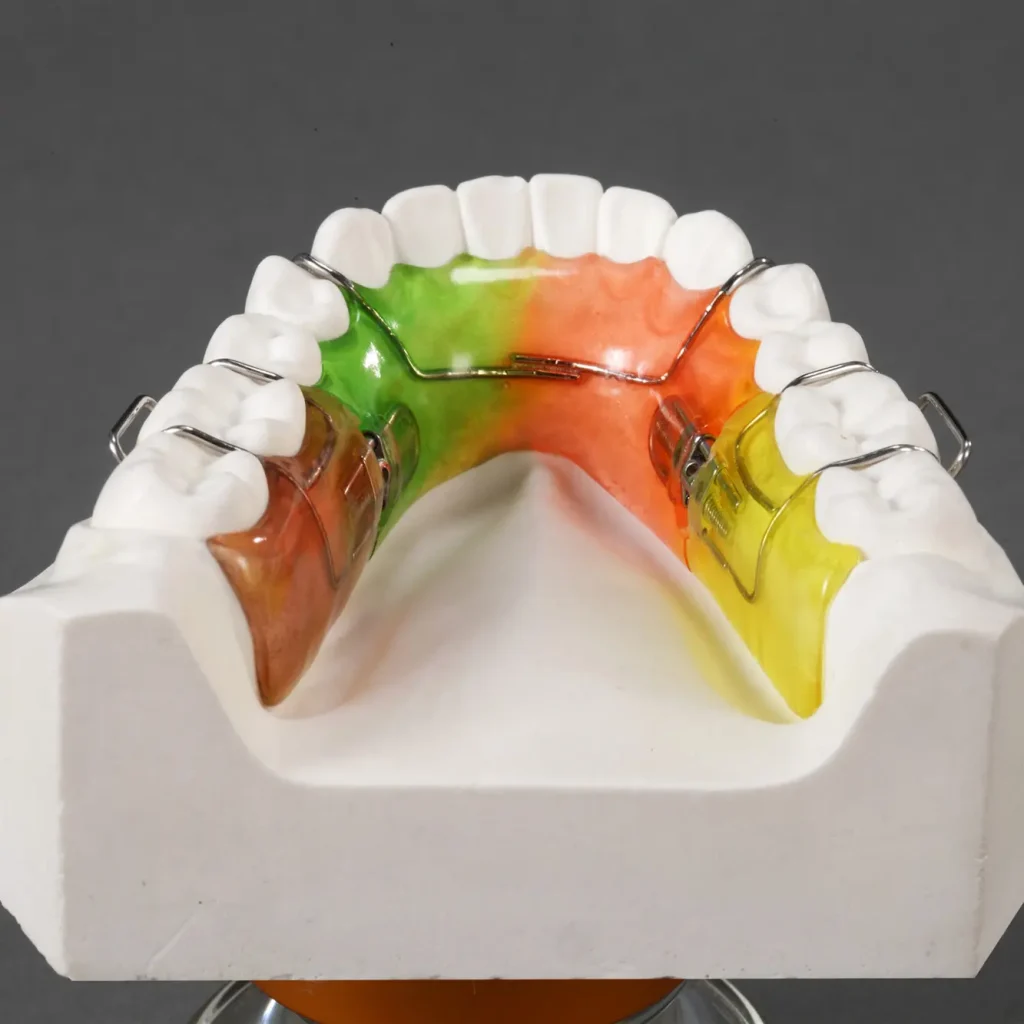
- Space Maintainers: Special appliances that reserve the space for upcoming permanent teeth for primary teeth that have to be extracted early.
- Trauma Management: Emergency medical repair for broken or displaced teeth due to falls or impacts.
Why Do Dental Cavities Occur in Children?
Bacteria ferment food residues in the oral environment to produce acid. Due to their structural properties, milk teeth are more susceptible to these acid attacks, and carious lesions can spread rapidly, easily reaching the nerve tissue of the tooth. The commonly encountered “bottle decay” (early childhood caries) is usually associated with giving the infant a bottle containing sugary, honeyed milk or fruit juice during or just before sleep.
Since the flow rate of saliva decreases during sleep, sugary liquids remaining in the mouth pool around the teeth, creating an ideal breeding ground for bacteria. Not cleaning the teeth after meals prepares the ground for this harmful plaque layer to stay on the enamel for hours, eroding the tissue. Limiting children’s consumption of junk food to main meals instead of snacks plays a significant role in reducing these risks.
How is a Dental Examination for Children Performed?
A child entering a clinical environment for the first time may naturally feel anxiety in response to unfamiliar sounds and devices. The pediatric dentist establishes a communication bridge by chatting with the child about their interests before starting the examination. The dental chair, lights (reflector), or air-water spraying instruments are introduced to the child as if they are part of a game (for example, calling the air tool a “wind machine”).
The child is asked to count their teeth with a mirror while the dentist examines the surfaces of the teeth, enamel structure, and gums with the help of the mirror. Without any coercion (pressure), this process is carried out step by step to assess the child’s cooperation. If the child refuses to undergo treatment during that session and the intervention is not urgent, the appointment will be limited to just the examination, and treatment will be planned for the next visit.
How are Pediatric Dental Treatments Planned?
In the clinics of Izmir Avrupadent, when designing treatment plans for pediatric patients, the timing of each tooth’s loss is calculated physiologically. For example, if a primary molar is significantly decayed, the permanent tooth underneath is checked through X-rays to see if it will erupt within 6 months; in such a case, instead of performing root canal treatment on that tooth, it might be preferred to extract the tooth and wait for the permanent one. However, if there are still 4 years until the primary tooth is expected to fall out, root canal treatment could be performed to retain the tooth in the mouth, thereby preserving jaw development.
The patient’s cooperation is the most critical aspect of planning. In very young children who have numerous cavities and cannot cooperate for treatment (where cooperation cannot be established), splitting the sessions over weeks might cause trauma; therefore, it could be decided to organize the process to be performed in a single session under sedation or general anesthesia.
How is an Evaluation Made Before Pediatric Dental Treatment?
Before starting medical treatments, being knowledgeable about the child’s health history can help prevent possible complications. For children with chronic illnesses or those using regular medications, dental treatment should be clinically approved in consultation with a pediatric specialist (child doctor). In intraoral evaluation, not only the cavities but also the structure of the gums, the adequacy of tooth brushing habits, and the speed of saliva flow are examined.
In radiographic evaluations, panoramic films are frequently employed. These films show the number, direction, and existing root resorption levels of permanent tooth buds developing under the bone that are not yet visible in the mouth. All these analyses clearly delineate the limits of the fillings or preventive applications to be performed.
What Are the Preventive Dentistry Practices in Children?
The focal point of modern pedodontics is not to treat diseases (cavities) after they occur, but to establish biological barriers that prevent those problems from starting at all. The main preventive measures taken in a clinical setting include:
What is Fluoride Application and Sealant in Children?
The fluoride mineral combines with the hydroxyapatite crystals in the dental enamel to form a harder structure called fluorapatite. This structure provides a defense shield against the acidic environment created by sugary foods in the mouth. In the clinic, fluoride gels or varnishes are applied to the tooth surfaces within seconds using special brushes. This procedure is refreshed at intervals determined by the dentist based on the risk group (usually every 4-6 months) to repair (remineralize) the weakened parts of the enamel.
The fissure sealant (tooth varnish) application focuses on the indentations on the tops of the back molars. Newly erupted molars have fine and narrow grooves on their chewing surfaces (fissures); the bristles of the toothbrush cannot enter these narrow grooves. The dentist drops fluid resin materials into these grooves without drilling (without cutting) the tooth surface and hardens them with blue light. The indented surface is flattened into a smooth surface, preventing food from getting stuck in that area.
Why is Treatment of Milk Teeth Important?
Milk teeth are temporary yet indispensable organs that should remain in the mouth until approximately the age of 12. If a milk tooth becomes inflamed due to decay, the child may experience pain while chewing, potentially leading to a refusal to eat, which can negatively impact overall physical development. If the decay progresses to the jawbone from the root, it can damage the still-budding enamel of the permanent teeth (hypoplasia).
Even more crucial is the protective (space maintaining) role of milk teeth. If a milk molar is extracted prematurely due to decay, the surrounding teeth can gradually tilt into the space. As a result, there may not be enough room for the permanent teeth to emerge; they may become impacted or erupt in a crooked manner. Therefore, keeping milk teeth in the mouth until they fall out, through fillings or root canal treatment, reduces the need for complex orthodontic treatments later on.
How to Proceed in Case of Dental Traumas in Children?
During childhood, scenarios of trauma from play, sports, or falls frequently involve fractures, looseness, or complete displacement (avulsion) of the front teeth. If the broken piece of the tooth can be found, the doctor can integrate that original piece back into the tooth using special bonding agents. This is the most qualified approach to preserving aesthetic integrity.
If a permanent front tooth has been completely knocked out of its socket, it should not be wrapped in a dry tissue or rinsed with tap water to prevent the living cells on the root surface from dying. If the tooth is transported in cold milk or the child’s saliva to the clinic (especially within the first 1-2 hours), the doctor can reinsert the tooth into its socket and stabilize it with wires to the adjacent teeth. If primary teeth are knocked out, they should not be placed back into their socket due to the risk of damaging the underlying permanent tooth.
When is Tooth Extraction Evaluated in Children?
Although the main principle in pediatric dentistry is preservation, it is a medical necessity to extract teeth that have become a source of infection and affect the body’s health. Sometimes, the roots of primary teeth do not dissolve within the expected physiological time; the incoming permanent tooth has to erupt through a different route (inward or sideways) because the primary tooth above it has not fallen out. In these arrangements, known as double rows (shark teeth), the extraction of the primary tooth is performed to support the natural progression of the permanent tooth towards its own natural form.
If a primary molar tooth had to be extracted due to inflammation more than 1 year before its expected shedding time, maintaining the space becomes very important. After the extraction wound heals, supportive “space maintainer” appliances are designed to prevent neighboring teeth from tilting into the tooth gap.
What Are the Approaches Used in Pediatric Dental Treatments?
Children’s responses to treatment are different from those of adults. Pedodontists apply various behavior guidance techniques while performing the procedure. To divert the child’s focus away from the operational tools, storytelling or showing their favorite cartoons (to draw attention elsewhere) is often preferred. After a successfully completed filling, the child is given small rewards to reinforce the positive experience.
However, in very young children (for example, those aged 2-4), in children who cannot communicate or have mental/physical special needs, prolonged procedures in the chair can cause sudden movements and consequently injuries. In such cases, all extraction and filling procedures in the child’s mouth are completed in one session under the supervision of a specialist anesthesiologist in fully equipped operating room conditions (with sedation or general anesthesia), so that the child does not experience any medical stress.
How Should Oral and Dental Care be Provided for Children?
Children’s fine motor skills develop fully only around the age of 7-8. Therefore, the brushing done by young children alone is generally insufficient, and plaque accumulation continues on the back surfaces of the teeth. The brushing process should not be left to the child; after the child brushes, the parent should take the brush and thoroughly clean all tooth surfaces (front, back, and chewing areas).
Toothpaste use should start at the age when the chewing reflex develops. For young children, a smear of toothpaste (about the size of a grain of rice) is sufficient, while for school-aged children, a pea-sized amount of toothpaste is appropriate. Once primary teeth begin to touch each other, the use of dental floss (with child-friendly handles) should be added to evening brushing to prevent food remaining in the interdental spaces from causing decay.
Why are Control Examinations Important in Pediatric Dentistry Treatments?
Children’s oral dynamics change much more rapidly than adults. A primary tooth that looks healthy a few months ago can quickly become infected due to a silent caries starting from the interface. During the periodic visits planned every 6 months, not only the dental caries are checked, but also the sequence of tooth eruption and the interrelationship of the jaw bones are under control.
If a child has a habit of breathing through the mouth chronically due to tonsil or adenoid problems, this can lead to the narrow (V-shaped) development of the upper jaw. Early diagnosis of such skeletal deformities by the physician ensures that jaw development is directed in the correct path through a collaborative effort with an ENT specialist.
When Should Orthodontic Assessment Be Done in Children?
In society, there is a prevalent idea that one must wait for all primary teeth to fall out and permanent teeth to emerge before starting treatment with braces (average age 12). However, if a child’s lower jaw is significantly forward (prognathism) or their upper jaw is narrow, these problems are not just related to the “alignment of teeth” but also concern the growth of the skeleton (bone). The resolution of skeletal issues can be managed much more comfortably with palatal expanders or functional appliances during the 7-10 age range, when the bones are still in the growing stage.
After the age of 12, the hardening of the jaw bones (closure of growth plates) is largely completed, so interventions after this age to expand or move the jaw forward generally require surgical support. Even if no issues are identified during an examination at the age of 7, the development of the jaw continues to be monitored annually to plan the appropriate treatment timing.
Can Children’s Dental Treatments Be Planned Together with Other Dental Treatments?
In a children’s hospital, many different processes can develop simultaneously in a child’s mouth. For instance, while a decayed milk tooth causing pain is extracted due to deep caries, measurements can be taken within the same session to plan a “space maintainer” apparatus to prevent future space issues for permanent teeth. Designing treatments to follow each other in a chain protects the integrity of jaw development.
In children requiring multiple procedures and treated under general anesthesia, this collaborative structure reaches its most efficient state. When the child is sedated, doctors can perform fillings or root canal treatments on all decayed teeth, remove those that need to be extracted, and complete fluoride applications. This way, the fatigue of numerous appointments spanning months can be eliminated with just one session, providing complete oral rehabilitation.
How is a Personalized Treatment Plan Made in Pediatric Dentistry?
The treatment path of two children of the same age and the same number of decays can be completely different. If the child’s temperament is calm and adaptable on the chair, procedures can be completed in the clinic with standard protocols spread over sessions using local anesthesia. However, in a child who exhibits intense anxiety about dental procedures or shows no limits in movement, this insistence may create psychological trauma; the physician personalizes the process by planning sedation accordingly.
Additionally, the “dental age” determined in radiographic examinations at the Izmir Avrupadent branches guides the calendar. In the films of a child who is chronologically 8 years old, the roots of the primary teeth may still not have resorbed at all; in this case, it is a personal medical decision to preserve the tooth with a filling instead of extracting it. The frequency of protective fluoride varnish applied is specifically determined by the child’s sugar consumption habits (specific decay risk group).