
What are Implant Supported Dentures?
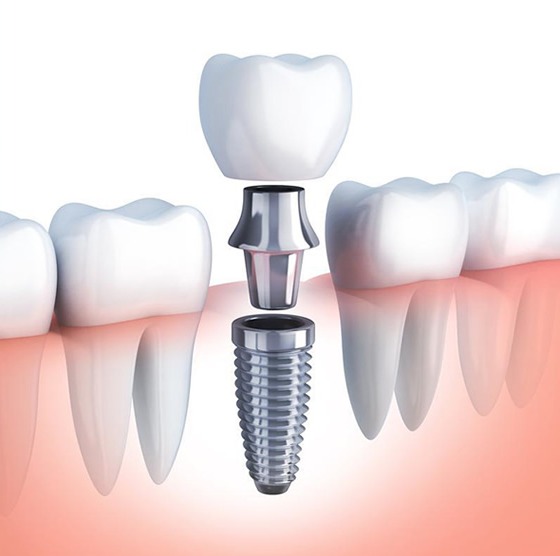
A natural tooth is anchored in the jawbone by its roots and transmits the chewing pressure to the bone through these roots. When a tooth is lost, not just the visible crown part disappears, but the root structure inside the bone also vanishes. The fundamental philosophy of implant-supported prostheses is to mimic this lost root structure with titanium screws and to construct porcelain or zirconium teeth that are tailored to the individual’s facial anatomy and bite alignment on this solid infrastructure. Unlike traditional methods, in these systems, the prosthesis is supported directly by osteointegrated artificial roots rather than soft tissues (gums) or adjacent natural teeth.
The implant-supported prosthetic approaches realized at the Avrupadent clinics located in Izmir are comprehensive processes that combine the dynamics of the jawbone with the integrity of the gum tissue (pink aesthetics). The individual’s expectations regarding speech (phonation), chewing (mastication), and appearance are met at a level very close to the natural tooth sensation with these technological restorations integrated into the oral structure.
When Are Implant-Supported Prostheses Used?
Tooth loss quickly alters the balance inside the mouth. If the gaps are not filled in time, neighboring teeth may tilt into the gap and lead to the onset of cellular resorption in the jawbone. Prosthetic solutions are planned to overcome these negative effects in various clinical conditions:
| Clinical Condition | Explanation and Functional Impact |
|---|---|
| Single Tooth Deficiencies | Independent coating applied to a single titanium root placed in the gap without reducing the nearby healthy teeth. |
| Free Ended (Posterior) Losses | When the teeth at the back of the jaw are lost, planning for implant-supported partial prostheses due to the absence of a tooth to support the bridge. |
| Wide Gap Multiple Losses | In cases where the existing natural teeth cannot carry the load in long gaps, bridging the spaces with implant-supported bridges. |
| Complete Edentulism (Total Edentulism) | In patients who have difficulty using a denture, permanent or supported movable tooth arrangements with strategically placed artificial roots on the jaw. |
How are Implant-Supported Prostheses Planned?
The collaboration of surgical and prosthetic (prosthesis) specialties means that every detail is interconnected in this process. In the Izmir Avrupadent system, planning is done from the back to the front. That is, the doctor first determines the shape, size, and position of the prosthesis that will be in the patient’s mouth at the final stage in a virtual environment. The implants inside the bone are organized in such a way as to balance the chewing forces that will be placed on the planned prosthesis.
Once the integration period of the titanium screws with the bone (osteointegration) is completed, the main prosthesis planning sessions begin. The gum shapemakers are removed, and measuring pieces are placed inside the artificial roots. These precise measurements are combined with the symmetry of the facial line and aesthetic of the smile to be transformed into functional structures in dental laboratories.
Who Might Be Suitable for Implant-Supported Prostheses?
There is no upper age limit for the application; as long as the bone quality is appropriate in later years, it can be comfortably planned. The important criterion is that the width and height of the jawbone have sufficient density to envelop the artificial roots. If a deficiency in the amount of bone is detected, the area is prepared with advanced surgical support like the addition of bone graft (powder) to ensure suitability.
In individuals with systemic diseases such as diabetes, hypertension, or osteoporosis, the process can be initiated after consultation with their primary care physician and monitoring of clinical values. Preparing the health foundation directly supports the clinical lifespan of the prosthesis to be placed.
How is an Assessment Done Before Implant Supported Prosthetic Treatment?
The base that will support the prosthesis is made up of both titanium root and the surrounding gum tissue biotype. The doctor checks for the presence of a hard tissue known as the ‘attached gingiva’ around the implant, which is resistant to dental flossing traumas. In cases where this tissue is lacking, food accumulation around the prosthesis will increase, so small gum tissue transfers are done before moving on to the prosthetic phase to establish healthy limits.
Additionally, the relationship between the lip distance and vertical dimension of the patient is analyzed. In patients who have experienced tooth loss for many years, the jaws may have come closer together (loss of occlusion). With the measurements taken before the prosthesis is made, this vertical occlusion dimension is restored to its anatomical level, thereby alleviating the loads on the jaw joint.
Which types of prostheses are used in implant-supported prosthetics?
The type of prosthetic selected depends on the number of implanted implants, the amount of bone loss the patient has, and lip support. Medical options are applied in the following forms, suitable to the patient’s anatomy:
-
\t
- ▪ Crown Covers: Independent teeth made of porcelain/zirconium placed on a single implant to replace a missing tooth.
- ▪ Implant-Supported Bridges: Systems produced as a body of teeth supported by implants at both ends in case of three or more missing teeth.
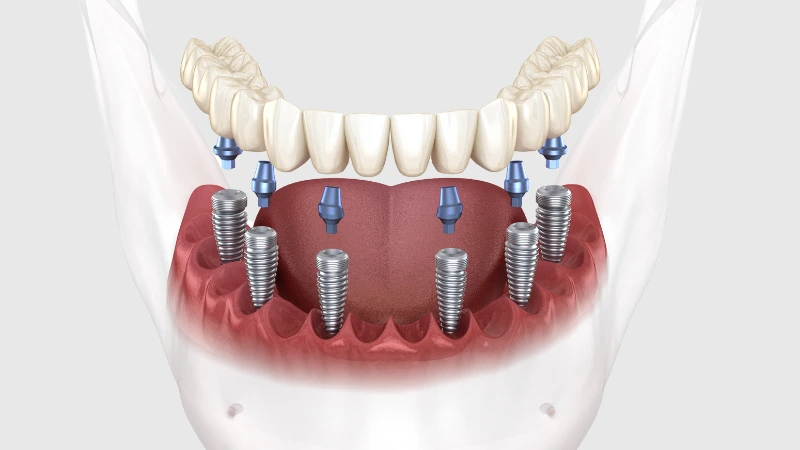
- ▪ Hybrid / All-On Concept Fixed Prostheses: Acrylic, porcelain, or zirconium bridges that are fixed onto 4 or 6 artificial roots applied to the jaw under complete anesthesia, covering the entire chewing area of the patient.
- ▪ Bar-Retained Removable Prostheses (Overdenture): Complete palatal prostheses that can be removed by the patient for cleaning, supported by 2 or 4 implants with friction mechanisms, for patients experiencing significant bone loss.
\t
What is the Difference Between Fixed and Removable Implant-Supported Prostheses?
To be able to apply a fixed prosthesis, there must be a sufficient number of artificial root supports in the jaw. If all teeth are missing in one jaw, a fixed bridge cannot be made by placing just 2 implants in that jaw; the biting pressure would break it. In this case, those 2 artificial roots are used to support the retention hooks (holders) for the removable denture that the patient uses, thus preventing the removable denture from falling out of the mouth while speaking.
| Comparison Feature | Fixed Implant Prosthesis | Removable (Overdenture) Prosthesis |
|---|---|---|
| Cleaning and Maintenance | Brushed inside the mouth, cleaned under the bridge with special cleaning threads. | Cleaned in the sink after removal from the mouth; the rubber inside is renewed by the doctor over time. |
| Volume and Shape | It is in the correct dimensions, and does not cover the palate. | It has acrylic (pink) extensions to compensate for bone loss. |
| Required Number of Artificial Roots | An average of 4 to 8 supports are required for a completely edentulous jaw. | An average of 2 to 4 supports may be sufficient for retention in a completely edentulous jaw. |
How Does the Implant-Supported Prosthesis Treatment Process Proceed?
The synchronization of the implants with the equipped external laboratories is essential. Once the surgical phase is completed, the doctor removes the cover screw from the implant and places a “healing abutment” (gingival former) to allow the gum to create a natural socket in that area (approximately 1 week). When this socket is formed, the impression components (impression posts) are screwed into the implants, and silicone or digital impressions are taken to map the exact position of the implant opening within the gum.
The zirconium or metal framework structures coming from the laboratory are tested in the patient’s mouth during the framework trial phase. The compatibility of the porcelain (the part of the white tooth) worked on these frameworks with the closing relations and the lips is checked during the tooth trial phase. In the final stage, the restorations are fixed onto the connecting elements called abutments, completing the process.
What Steps Are Followed in Implant-Supported Prosthetic Applications?
The clinical steps from start to finish form a chain of protocols aimed at minimizing the margin of error at each step. The application steps are as follows in detail:
- ▪ 1. Impression Acquisition: The complete openings of the titanium roots within the jaw are copied using digital scanners (CAD/CAM) or conventional impression materials.
- • 2. Infrastructure Trial: The millimetric control of the marginal adaptation of the carrier skeleton (zirconium/metal) prepared in the laboratory with the tissues inside the oral cavity.
- • 3. Porcelain / Aesthetic Trial: The color tone of the artificial teeth processed on the skeleton, its proportion to the face, and the chewing axes being mutually approved by the patient and the physician.
- • 4. Delivery and Cementation (Screwing): The prosthesis that has undergone polishing (glaze) is fixed by screwing or binding with medical adhesive agents, depending on the physician’s decision.
How is the Oral and Jaw Structure Evaluated for Implant-supported Prostheses?
Especially in cases of multiple tooth loss, patients’ jaws come closer together than they actually are when they close (reduction in occlusal height). When designing the prosthesis, this reduced facial distance is restored to its former anatomical position, allowing the jaw joint (TMJ) to gain the correct position. This distance adjustment is a key factor that determines the height and thickness of the porcelain to be used in the prosthesis.
If the distance between the upper and lower jaws has significantly narrowed, or if there are horizontal reductions in areas with tooth loss due to gum retraction, the design of the prosthesis is planned to mask this. If necessary, by adding “pink porcelain” that mimics the natural gum into the base of the porcelain, it prevents the surrounding lip tissues from appearing sunken and aged.
What Should Be Considered Before Implant-Supported Prostheses?
For the measurement procedures to be of microscopic precision, it is essential that the soft tissue surrounding the titanium structures is completely healthy and free from inflammation. If there are gum bleeding or inflamed tissue swellings related to plaque accumulation, the measurement parts cannot fit perfectly into their sockets. For this reason, it is necessary for patients to pay extra attention to brushing routines before the process begins from a clinical standpoint.
Additionally, during the trials, it is important for the patient to express their expectations clearly to the physician in front of the mirror. Once porcelain materials are taken out of laboratory furnaces and polished, making structural dimensional changes on them is quite difficult; these revisions are aimed to be clarified while they are still in the skeletal and wax phases.
What Should Be Considered After Implant Supported Dentures?
When a new volume is created in the mouth, the adjustment phase of the cheek tissues and tongue to this new area begins. In this phase, small lisping may occur during speaking, or the cheeks may unconsciously bite while chewing. The adaptation of the muscle memory to this new restoration is completed within a few days.
If the treatment was completed with a removable system rather than with screws, taking a break from the chewing process is important to ensure that the chemical bonds (cements) do not leak into the tissues. In very rare cases, early contact (height) may be felt between the teeth and the opposite jaw. This situation should not be neglected due to the risk of excessive vertical pressure on the implant body; it should be relieved with minor clinical trimming (polishing) at that point.
How Should Implant-supported Prostheses Be Maintained?
Artificial roots do not rot, but the gum and bone tissue surrounding the titanium construction is much more sensitive to infections compared to natural teeth. If food debris and bacterial plaque accumulate at the junction between porcelain teeth and the gums, an infection known as “peri-implantitis” can develop. This infection can trigger bone loss, leading to the complete loss of both the prosthesis and the titanium root.
Therefore, especially in connected (block) long bridges, the spaces underneath the bridge must be cleaned with special cleaners as floss cannot reach those areas. Users of removable dentures (overdenture) should remove their prosthetics every night before bed, and the acrylic surfaces should be brushed with special soft brushes and liquid soap to aerate the oral tissues.
What Materials Are Used in Implant-Supported Prosthetics?
When constructing an artificial tooth, the fundamental principle is that the material must not react with the human body (biocompatibility). The abutments that connect prosthetics to titanium roots are usually made from medical-grade titanium. However, to avoid a gray metallic reflection from the gum in the aesthetic zone (in the front teeth), these components can also be designed entirely from white zirconium.
| Material Type | Characteristics and Areas of Use |
|---|---|
| Zirconium Frameworks | Biocompatible alloys that combine high aesthetic reflection and fracture resistance, used in both anterior and posterior fixed bridges. |
| Metal Supported Porcelain | Traditional porcelain solutions that withstand chewing loads on long-span posterior bridges without distortion. |
| Hybrid Acrylic (All-on-4) | Composite or acrylic arrangements processed over a metal framework to reduce the burden on the jaw in fixed restorations for the entire arch. |
| Titanium Abutments | Main support mechanism parts that ensure the locking of the structure within the bone to the porcelain tooth. |
How Many Stages Can Implant Overdentures Be Completed In?
Prosthetic procedures are logically interconnected. In the first stage, precise measurements are taken with transfer pieces that accurately replicate the connection openings of the patient. This process can be completed in a single session using digital scanners. The supportive structure prepared on the models cast in the laboratory is tested in the mouth during the second stage called “framework trial”.
In the third session, the closure and visual aesthetics trial (tooth trial) of the structure worked on with porcelain or tooth forms is evaluated with the patient. If the patient approves the shape, the restoration baked for the final glaze is attached to the abutments in the fourth session and screwed in (or built up). The duration and number of sessions vary depending on the volume of the prosthesis (single tooth or entire jaw).
Why is Control Examination Important in Implant-Supported Prosthetic Treatment?
In the procedures at Izmir Avrupadent, the delivery of the procedure is not the end of treatment but the beginning of long-term functional monitoring. Chewing forces over the years can cause micro loosening in the screws that hold the prosthesis. During routine check-ups, the physician tightens these screws with torque wrenches to renew the stabilization of the restoration.
Additionally, small x-rays (periapical images) taken in six-month intervals examine the bone lines surrounding the titanium roots. If the formation of a gum pocket associated with possible food trapping (peri-implantitis) is observed at an early stage, it can be halted using professional cleaning methods before it reaches the disease bone, thereby extending the lifespan of the structures.
What is the Difference Between Implant-Supported Prosthetics and Traditional Prosthetics?
The protective principles of modern dentistry avoid cutting (shaving) healthy dental tissues as much as possible. To create a traditional bridge, the healthy teeth on either side of the edentulous space are typically reduced by 1-2 mm. Implant-supported systems allow for the direct placement of a root into that space, leaving the neighboring teeth completely out of the treatment process. Interactions can be presented as follows:
| Clinical Parameters | Implant-Supported Prosthetics | Traditional Prosthetics |
|---|---|---|
| Tissue Preservation | Healthy neighboring teeth are untouched, and structural integrity is preserved. | It is necessary to contour the crown parts of the neighboring teeth for support. |
| Bone Resorption (Dissolution) | Due to the pressure applied to the bone from inside, it stimulates bone volume and halts resorption. | The bone beneath the gap continues to shrink (dissolve) over time because it was not stimulated. |
| Retention Force (Total Toothlessness) | The prosthesis is mechanically fixed or tightly attached, eliminating the possibility of it falling out. | It can only move when speaking or stretching because it relies solely on the vacuum of the palate. |
In What Cases Can Implant-Supported Prosthetic Treatment Be Evaluated for Tooth Loss?
The surgical and prosthetic alternatives offered by technology allow for the planning of restorations suitable for all gaps, regardless of localization. The areas evaluated by the physician are as follows:
- Losses in the Anterior Region (Aesthetic Area): In cases of loss of incisors, special zirconium abutment single prostheses designed to perfectly mimic the pink form of the gum provide functional and visual balance.
- Losses in the Posterior Region (Chewing Area): In the absence of molars, metal-supported or monolithic zirconium bridges that can resist the heaviest chewing forces without bending are designed, thereby regaining mechanical digestion.
- Multiple Implants: Separately or in groups, blocks are designed for each of the voids accumulating in different areas, maintaining the overall curvature of the jaw.
How is Personalized Treatment Planning Done for Implant-Supported Prostheses?
In medical processes, each tooth does not fit every mouth. In complete jaw restorations (All-on concepts), the design of the prosthesis includes not only the arrangement of the teeth but also the support to be provided from the inside to the lips (lip fullness). A prosthesis made for a patient with significant bone loss should mask the concavity on the patient’s face by pushing the upper lip, providing a natural expression.
The physician determines the porcelain reflection by considering the patient’s skin color and age characteristics during planning. While more rounded transitions are planned for female patients, straighter and more masculine cutting edges are designed for male patients. This way, the applied teeth also bear an aesthetic anatomical signature.