
What is All-on-6 Dental Implant Treatment?
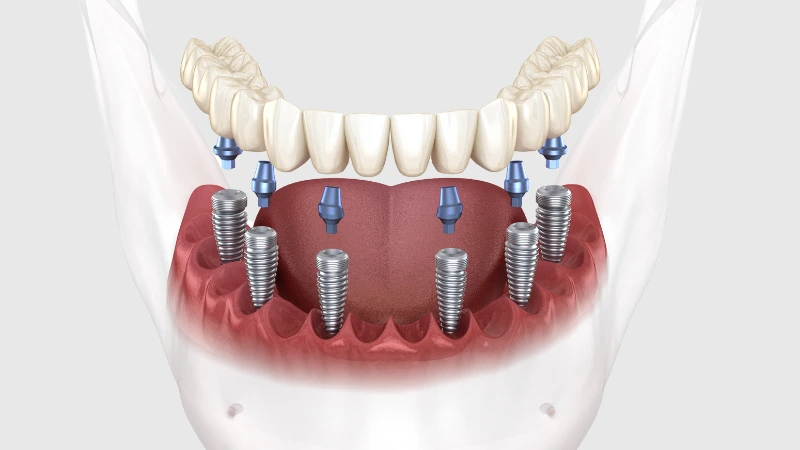
In previous years, individuals with complete edentulousness typically used removable dentures supported by the gum tissue. However, as the jawbone loses volume over the years, these dentures tend to move in the mouth, leading to decreased chewing comfort. The All-on-6 concept allows balanced transmission of all chewing forces to the bone through 6 fundamental support points placed in the most anatomically resilient areas of the jawbone. This biomechanical system enables the individual to perform their chewing function with fixed teeth.
In the Avrupadent clinics located in Izmir, All-on-6 dental implant plans are developed in a multidisciplinary framework, considering the patient’s jawbone volume and facial ratios. This clinical process aims to offer chewing stability that is very close to the natural feeling of teeth for individuals struggling with removable dentures. The surgical techniques applied and the prosthetic superstructures are shaped based on clinical requirements aimed at preserving the balance of the jaw joint and aesthetic profile overall.
In which situations can All-on-6 Dental Implant Treatment be considered?
This specific concept is designed to address the functional and aesthetic gaps created by multiple tooth deficiencies. Placing a separate artificial root for each missing tooth in the jaw may not always be anatomically feasible or could cause unnecessary clinical fatigue. All-on-6 is an engineering approach that aims for maximum stability with an optimal number of supports. The main situations that lead to the preference for this method in clinical practice are as follows:
| Clinical Condition | Explanation and Functional Needs |
|---|---|
| Total Toothlessness | Due to the absence of any natural teeth in the mouth, there is a need for the chewing action to be supported by fixed systems. |
| Destruction of Existing Teeth | The few remaining teeth in the mouth are too loose to be supported by a bridge due to advanced periodontal disease. |
| Removable Prosthesis Intolerance | Problems with retention (movement) experienced while speaking or eating with the patient’s palate prosthetics. |
| Management of Bone Resorption | Planning mechanical supports that will send signals from the inside of the jaw to control bone resorption. |
How is All-on-6 Dental Implant Treatment Planned?
In the clinical processes of Avrupadent, the All-on-6 concept is designed from a “prosthesis-focused” perspective. In this approach, before the operation begins, the physician virtually creates the shape of the main prosthetic tooth that includes the gum support and lip fullness suitable for the patient’s facial profile. The areas of bone where the titanium roots will be placed are organized in a way that directly corresponds to the load-bearing points of this prosthesis (chewing centers).
During the planning phase, nerve pathways passing through the jaw (mandibular canal) and sinus air cavities in the upper jaw are accounted for within safety limits. Specific openings with suitable bone structure are preferred, ensuring that the pressure exerted on the prosthesis is distributed evenly across the jaw. This meticulous engineering effort is a clinical necessity for the long-term functionality of the system.
Who Could Benefit from All-on-6 Dental Implant Treatment?
As long as bone health is at sufficient levels, age factor is not a restrictive criterion for this procedure. Bone density is the primary factor that directly affects the success of the integration (osteointegration) of the implanted artificial root. If there is not enough space in the individual’s jawbone for 6 supports, advanced reconstructive surgeries such as bone grafting (bone powder addition) are first planned to structurally prepare the region for suitability.
Patients with diabetes or cardiovascular diseases can be included in this process under the supervision of their own healthcare provider and during periods when their clinical values are stable. Adherence to post-operative oral care rules set by the hospital is another suitability factor that determines the long-term maintenance of the procedure.
How is an Evaluation Conducted Before All-on-6 Dental Implant Treatment?
Successful prosthetic surgery is possible with a thorough evaluation of the underlying infrastructure. The physician assesses how closely the jaws are aligned due to the patient’s long-term edentulism (loss of vertical dimension). The thickness of the mucosa in the area where the prosthesis will sit is examined. If there are residual teeth that can lead to bone resorption, the condition of these infection foci is identified, and it is incorporated into the surgical schedule.
Moreover, it is inquired whether the patient is taking any anticoagulants or medications that regulate bone metabolism. Depending on the medications used, a consultation with a physician is requested prior to the operation to ensure issues like bleeding and wound healing are managed. Habits that slow cellular repair, such as smoking in the patient’s daily life, are also included in the assessment.
What Diagnosis and Imaging Methods are Used in All-on-6 Dental Implant Treatment?
The concept is based on reading the anatomical boundaries within the bone with millimetric precision. The specific diagnostic tools used in the clinic to ensure this clarity are as follows:
- Dental Volumetric Tomography (CBCT): This is the main imaging system that shows the jawbone in three-dimensional sections, determining the width, density (D1-D4 type), and the location of the inferior alveolar nerve canals.
- Panoramic Radiography: It allows for the visualization of the entire structure of the jaws in a single plane, analyzing the general level of bone resorption and adjacent anatomical areas.
- Intraoral Optical Scanners: These are camera systems that digitally replicate jaw arches and transfer them to a computer environment for the 3D modeling of prosthesis design.
- Photographic Facial Analyses: By recording the position of the lips and the facial symmetry during smiling, it serves as a reference for designing the dimensions of the prosthetic teeth.
How Does the All-on-6 Dental Implant Treatment Process Progress?
The operation is typically performed under local anesthesia (or with sedation support if needed). If there are teeth that need to be extracted, they are removed in the same session, and titanium structures are placed with specific openings into the opened sockets or pre-healed bone areas. An important feature of All-on concepts is that, in cases where bone density allows, a temporary fixed bridge can be placed immediately after the procedure (immediate loading), allowing the patient to leave the clinic without leaving toothless.
After the surgical phase, it is expected that the bone will cellularly adhere to the titanium structure (osseointegration). This biological adaptation process averages around 3 months, depending on the structure of the jaw. Once healing is complete, temporary prostheses are removed, and precise measurements are taken to match the final form of the gums before proceeding to the fabrication phase of the permanent restorations (zirconium/porcelain hybrid prosthetics).
What Stages Are Followed in All-on-6 Dental Implant Treatment?
The protocol consists of the steps in which surgical and laboratory procedures are integrated with each other. The clinical pathways followed in standard practice are as follows:
| Application Stage | Clinical Details of the Procedure |
|---|---|
| Surgical Intervention | Performing extractions in the anesthetized area, if necessary, and placing 6 support roots according to the computer planning. |
| Temporary Prosthesis Adaptation | Screwing in a temporary fixed bridge with restricted chewing force within a few days after the procedure (depending on the suitability of the bone). |
| Biological Waiting (Ossification) | Months spent for the bone to cellularly encapsulate the artificial roots. |
| Permanent Prosthesis Delivery | The definitive measurements obtained after the tissues are healed are used to permanently fix the aesthetic and functional prosthesis prepared in the laboratory. |
What Should Be Considered Before All-on-6 Dental Implant Treatment?
In surgical interventions, the goal is to keep the microbial load in the working area at a minimum level. If there are teeth that are sources of infection in the patient’s mouth, keeping these areas as hygienic as possible through brushing or mouthwashes before the procedure reduces the risk of complications that may arise afterwards.
Additionally, since the duration of the procedure may last several hours per jaw, having the patient present at the clinic in a psychologically and physically relaxed state enhances clinical comfort. In necessary cases, sedation protocols (sleep state) administered intravenously for patients with high anxiety can help to make the surgical process feel calmer from the patient’s perspective.
What to Pay Attention to After All-on-6 Dental Implant Treatment?
It is common to observe slight reactive swelling (edema) and small leaks in the tissues immediately after the procedure. When the analgesics and antibiotics prescribed by the doctor are taken according to schedule, the healing process is quite controlled. Patients are advised not to sneeze, gargle, or drink with a straw (creating suction) during this period; as these actions can disrupt the clot at the wound site.
The purpose of the temporary prostheses that are placed is to provide an aesthetic appearance and facilitate speech; they do not have the structural resistance to counteract the actual chewing force. To prevent excessive pressure on the jaw during the healing phase, it is clinically necessary to avoid the consumption of hard and tearable foods (such as apples, nuts, hard bread) until the permanent prostheses are placed.
How are the Lower and Upper Jaws Assessed in All-on-6 Treatment?
In the upper jaw, the areas at the back where the molar teeth are located anatomically contain maxillary sinus (air) cavities. As the duration of toothlessness increases, these cavities sag downwards, reducing bone volume. In the All-on-6 design, the physician aims to place 6 artificial roots at balanced distances either by avoiding these sinus cavities or by performing sinus lifting (bone powder addition) in those regions.
In the lower jaw, the most important determining factor is the mandibular nerve, which passes through the lower jaw bone and provides sensation to the lip. The lengths of the bodies to be placed in the back regions are specially selected according to the safety distance from this nerve. Because the lower jawbone is structurally denser (harder), the initial retention resistance of the screws is generally higher compared to the upper jaw.
How is Fixed Prosthesis Planned in All-on-6 Dental Implant Treatment?
The restoration performed to correct the deficiency in the patient’s facial profile will not only include teeth but also pink components (pink porcelain) that mimic the melted gum tissue, crafted in a laboratory environment. The clinician analyzes how much the upper teeth are visible in the patient’s smile and decides on the elastic modulus of the material to be used.
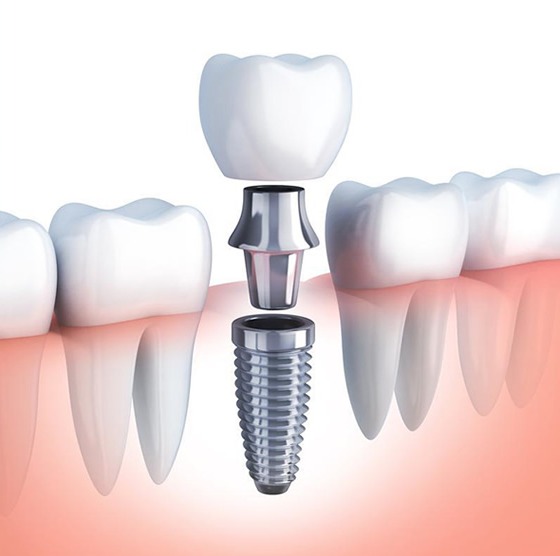
Another important feature of these prostheses is that they can typically be directly screwed onto the implant bodies (screwable system). Screwable prosthesis systems allow the clinician to easily remove the prosthesis during future clinical follow-up sessions to clean underneath it and perform routine maintenance comfortably, thus supporting the longevity of the treatment as a whole.
How Do Temporary and Permanent Prosthesis Processes Progress in All-on-6 Treatment?
The temporary prostheses placed on the day of the surgical procedure are usually made of acrylic-based, lightweight materials. Their purpose is to prevent the patient from being isolated from social life during the months waiting for bone healing and to facilitate the adaptation process of the cheek and lip muscles. During this period, the patient must adhere to soft diet rules rather than hard chewing functions.
At the end of the transition phase, the gum takes its final form and becomes consolidated. The doctor will remove the temporary bridge and take quite sensitive measurements according to the boundaries of this new gum. Permanent (fixed) prostheses are produced from materials with the highest level of biological compatibility and integrated into the mouth in a way that will not restrict aesthetic and functional chewing movements.
How Long Can All-on-6 Dental Implant Treatment Last?
The primary reason for the long duration is the time needed for the body to heal the titanium piece as if it were its own bone. On the day of the operation, the temporary teeth are installed so the person can return to daily life, but bone resistance is needed for the permanent material to be placed.
If the bone thickness in the jaw is found to be weak and the process was initially performed with bone graft (powder) for augmentation, it may take a few more months for the body to convert these powders into living bone. In the protocols of İzmir Avrupadent, a schedule compatible with the patient’s own anatomical findings is presented from the beginning to avoid surprises.
How is the Jawbone Evaluated in All-on-6 Treatment?
It is essential to distribute the support evenly along the jaw. The physician identifies the areas that have eroded (examined) due to teeth being extracted years ago and the relatively thicker remaining areas (like the front jaw). Not only the volume of the bone but also its hardness level determines the “primary stability” of the titanium piece placed.
If there is insufficient volume to support 6 screws in the digital examination conducted, the All-on-4 technique, which is placed with more flexible openings, may be implemented as an alternative, or bone grafting (reconstruction) may be planned through advanced surgery to bring the bone bed to appropriate dimensions prior to the operation.
How Should Oral and Dental Care be Performed After All-on-6 Dental Implant Treatment?
The applied ceramic or zirconium constructions are resistant to wear; however, the gum tissue surrounding the titanium bodies holding those constructions is quite sensitive. In fixed dentures, teeth are connected in a block (one piece), making it impossible to reach the spaces between them with classic dental floss. When food residues accumulating in the lower void of the prosthesis cannot be completely removed with brushing, it leads to a process of bone resorption known as “peri-implantitis”.
To overcome this infection issue, it is clinically necessary for patients to incorporate water jet flossers into their daily routines. In cases where hygiene is adequately maintained, these systems aim to serve the patient comfortably for many years.
Why is Control Examination Important in All-on-6 Dental Implant Treatment?
Artificial roots bond to the jawbone not with flexible attachments like natural teeth, but in an extremely rigid manner. This rigid structure can directly turn an unstable force acting on the prosthesis during chewing into mechanical pressure. During six-month or annual check-up visits, the physician monitors these contacts with carbon papers and alleviates any overloaded points with microscopic fileings (polishing).
Moreover, since the prostheses are made with a screwed system, the physician can completely remove the prosthesis from the mouth during the control session and thoroughly clean the gum margins underneath with professional devices, then reattach the prosthesis. This maintenance process is an indispensable stage for preserving the biological compatibility of the treatment.
What Treatments Can the All-on-6 Dental Implant Treatment Be Planned With?
The requirements of the process are shaped by the current anatomical condition of the patient. If the sinus cavities in the back areas of a patient who has been edentulous for many years in the upper jaw have sagged and the bone has thinned significantly, the sinus membrane will be elevated to place 6 implants, and bone tissue will be added underneath. This procedure is an advanced surgical support that strengthens the foundation of the All-on-6 concept.
Furthermore, cleaning the infections around the teeth that are loose and need to be extracted (curettage or cyst removal operations) can be included in the planning during the same session or in the biological preparation period before the surgery, ensuring the sterilization of the oral flora.
How is Personalized Treatment Planning Done in All-on-6 Dental Implant Treatment?
Each individual’s facial expression and jaw dynamics are different. In a patient with complete edentulism, a natural indentation around the lips occurs. The physician designs the outer surface of the prosthesis (lip) slightly fuller to mask this indentation and aesthetically support the patient’s facial proportions. In patients with longer faces, the teeth are designed more oval horizontally to achieve visual harmony on the face.
In planning, the distribution of titanium roots within the bone is personalized entirely according to the patient’s jaw curvature (narrow, wide, U-shaped, or V-shaped) using digital assistants (computer-aided programs). This way, the masticatory pressure is distributed in the healthiest manner, optimizing long-term functional capacity.