Is it necessary for all teeth to be completely extracted for implant placement?
It is not absolutely necessary for all teeth to be completely extracted for implant placement; this treatment method can be applied to fill gaps in cases of a single tooth loss, partial (regional) tooth losses, or complete edentulous situations. The fundamental principle of modern dentistry is to preserve the remaining healthy natural teeth in the mouth. Medical titanium roots placed into the jawbone are designed to take the place of lost teeth and work in harmony with the remaining healthy natural teeth without causing any harm to them.
Common misconceptions in society such as “implants are only made for those with no teeth at all” or “all teeth must be extracted for this treatment” are misleading information that do not reflect medical necessity. On the contrary, no artificial material can fully replicate the place of a healthy natural tooth. Therefore, dentists strive to preserve every tooth that can be treated with fillings, root canal treatments, or gum surgeries in the mouth. The decision to extract is only made in situations of medical necessity where tissue loss is irreversible. Implant treatment is a supportive medical procedure that protects the health of the remaining healthy teeth by closing existing gaps.
How is implant treatment applied in case of a single tooth loss in Izmir?
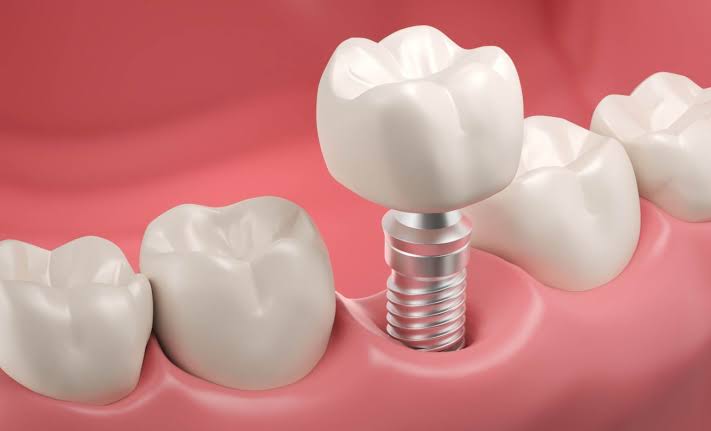
In İzmir, implant treatment for a single tooth deficiency involves placing a titanium body into the jawbone with precise measurements corresponding to the gap where the tooth has been lost, and after bone healing is completed, an independent porcelain or zirconium crown is placed on this body. This method ensures that no intervention (cutting or reduction) is performed on the healthy neighboring teeth in front of and behind the gap.
In previous years, the most common way to fill the gap when a single tooth was lost was to reduce the enamel tissue of the two neighboring healthy teeth and create a three-unit bridge prosthesis. However, in current and preventive dentistry approaches, it is essential not to touch healthy tissue. In the practices conducted in clinics in the İzmir region, an artificial root is placed in the missing area, transmitting the chewing forces directly to the underlying jawbone. This physiological transmission slows down the resorption of the bone beneath the gap and preserves the shape of the surrounding tissues.
| Evaluation Criteria | Traditional Porcelain Bridge | Titanium Supported Single Tooth (Implant) |
|---|---|---|
| Preservation of Natural Teeth | Neighboring teeth are reduced and used as support legs. | Neighboring teeth are untouched, and anatomical structures are completely preserved. |
| Effect on Jawbone | The bone beneath the gap will erode over time because it is not stimulated. | The chewing pressure is transmitted to the bone, supporting the cellular bone volume. |
| Hygiene and Cleanliness | Extra effort is required to clean under the bridge with special threads. | Just like classic dental floss, it can be easily cleaned with a toothbrush. |
Is it Possible to Implant Without Extracting Healthy Teeth?
Implanting without extracting healthy teeth is not only possible but also a medical necessity; because the primary goal of medical procedures is to preserve non-pathological (healthy) tissues while completing the missing parts. The more healthy natural teeth you have in your mouth, the more balanced and healthy a chewing system can be created by applying artificial roots that benefit from the anatomical guidance provided by these teeth.
The ethics of dentistry require that no healthy tooth can be sacrificed for the sake of a more aesthetic or easier prosthesis. The periodontal ligament, an elastic tissue that connects the root of the natural tooth to the jawbone, is an excellent shock absorber system owned by humans. This system detects chewing forces and stimulates the brain. Protecting natural teeth means preserving the jaw’s biological perception ability. Dentists thoroughly examine the teeth in the mouth and consider teeth without decay or gum disease as the main carriers or protective pillars in treatment planning.
How to Protect Natural Teeth in Cases of Multiple Tooth Loss?
In cases of multiple tooth loss, natural teeth in the mouth are protected by placing fixed bridges on titanium carriers inserted into the gaps created by adjacent missing teeth, ensuring that these bridges work completely independently of the natural teeth. While the natural teeth continue their functions, the artificial roots in the toothless areas compensate for the chewing forces, preventing excessive pressure on the natural teeth.
When back teeth are lost on one or both sides (partial edentulism), the person must transfer all chewing force to the front teeth or the remaining teeth on one side while eating. This uneven load distribution can lead to wear, looseness of healthy teeth over time, and discomfort in the jaw joint. Local treatments applied to the missing areas eliminate this imbalance and distribute the force evenly across the entire jaw. Thus, not only are the toothless areas filled, but the lifespan of the remaining healthy teeth in the mouth is also extended by protecting them from mechanical wear.
In Which Cases Is Extraction of Remaining Teeth Medically Considered Necessary?
Extraction of remaining teeth is considered medically necessary in cases where untreatable chronic cysts are present at the root tip, the bone support has completely dissolved due to gum disease (advanced periodontitis), causing the tooth to loosen in an irretrievable manner, or if there are deep fractures or cavities below the root level that cannot be restored.
Although preventive dentistry approaches always focus on saving the tooth, some clinical situations can make it harmful to keep the tooth in the mouth. For example, if a tooth with a severe gum infection that is eroding the jawbone is stubbornly tried to be kept in the mouth, that infection can also spread to the bones of neighboring healthy teeth. Additionally, there may be no sufficient healthy bone volume left for the future installation of a medical titanium structure in that area. Such infection foci become subject to extraction decisions as they threaten the health of the entire system based on the dentist’s objective radiological assessment.
-
\t
- Advanced Mobility (Looseness): Teeth that have lost bone support and can no longer function in chewing.
- Deep Root Fractures: Teeth that have vertically cracked or broken along the root due to trauma.
- Chronic Focus Infections: Persistent abscesses that do not heal with root canal treatment and apical surgery (root tip surgery).
- Insufficient Crown-Root Ratio: The lack of sufficient dental tissue that can be filled or capped when the tooth is cleaned.
\t
How Do Natural Teeth and Titanium Roots Function Together in the Jaw?
When natural teeth and titanium roots are present in the jawbone, they function together by responding to chewing forces through different biomechanical pathways. Natural teeth absorb force by flexing at the micro level thanks to flexible connective tissues (periodontal fibers), while titanium materials are rigidly bonded to the bone, so they do not flex; this mechanical difference is balanced by the precise occlusal adjustments the dentist will make.
This biomechanical distinction is one of the most intricate considerations in dentistry. On one side, there is a natural tooth that can slightly yield when a compressive force is applied; on the other side, there is an artificial root that does not budge even a millimeter as it is integrated with the bone. If the same bridge prosthesis connects one leg to a natural tooth and the other leg to a titanium root, this difference in flexibility can lead to mechanical problems over time (failure of the construction or damage to the natural tooth). Therefore, in modern medical approaches, natural teeth are connected with bridges among themselves, and titanium bodies are connected with bridges among themselves, with each system functioning according to its own biological rules.
Can Tooth Extraction and Implant Placement Be Done on the Same Day?
Tooth extraction and implant placement procedure; an immediate treatment can be performed on the same day under suitable anatomical conditions if there is no active abscess or inflammation at the root of the extracted tooth, the outer walls of the bone are not damaged during extraction, and the titanium material placed reaches a high primary stability force in the relevant socket.
The same day placement protocol is a modern method that significantly reduces the treatment duration for the patient and minimizes bone resorption in the tooth extraction site. Especially in cases of anterior tooth loss, since the bone on the lip side is very thin, waiting for the bone to heal after extraction can lead to resorption of that thin bone. The doctor extracts the tooth in an atraumatic (non-damaging) manner, cleans the socket with special medical solutions, and positions the artificial root at the correct angle. The small gaps around it are filled with biocompatible bone powders (grafts) to support tissue healing. However, the application of this method entirely depends on the findings during the clinical examination.
| Medical Criteria | Description and Importance |
|---|---|
| Infection-Free Environment | There should be no granulation tissue (inflammation) at the root tip, otherwise the surrounding new material becomes infected. |
| Bone Integrity | The outer and inner bone walls surrounding the tooth must be preserved without being fractured during extraction. |
| Root Apical Bone Quantity | There must be at least 3-4 mm of healthy bone for the material to anchor, located deeper than where the extracted root ends. |
What Is the Effect of Remaining Natural Teeth on the Implantology Process?
The impact of remaining healthy natural teeth on the Implantology process; it is extremely positive in terms of providing anatomical guidance to the physician by preserving the vertical jaw closure height (facial dimension), creating a natural reference for selecting tooth color and form during the prosthesis making stage, and allowing the patient to continue their chewing function uninterrupted during the healing process.
When planning treatment in a completely edentulous mandible, the physician must reconstruct the jaw height, the distance between the nose and the tip of the jaw, and the tooth form that the patient lost years ago based on old photographs or average anatomical measurements. However, even if there are a few natural teeth in contact in the mouth, these teeth contain the natural codes of the occlusal relationship. The new porcelain prostheses are designed according to the level and color of these healthy teeth in the mouth. In short, the remaining teeth are the most reliable natural guides that determine the architecture of the medical process.
How Does Treatment Planning Change in the Case of Complete Edentulism (Extraction of All Teeth)?
In the case of complete edentulism, treatment planning changes; instead of placing a separate root for each missing tooth in the individual’s jawbone, strategic support bodies (usually 4, 6, or 8) placed in the upper and lower jaws with specific openings are used by calculating the biomechanical force distribution, and fixed or removable prostheses (such as All-on concepts, etc.) covering the entire tooth arrangement are constructed on these systems.
If a patient has lost all their teeth within a few years or if all the teeth in the mouth are too diseased to be saved, a more comprehensive planning approach is introduced in dental surgery. In such completely edentulous cases, bone resorption is usually more advanced, and collapses in the facial tissues (loss of lip and cheek support) are observed. The treatment aims not only to restore the teeth but also to regain the aesthetics of the lost surrounding tissues. If the bone volume is sufficient, fixed porcelain bridges are designed; if there is significant bone loss, removable (overdenture) prostheses with pink acrylic support are created. These extensive plans are based more on the patient’s bone structure, systemic health, and the analysis of the lip profile than their age.
How Does Jawbone Analysis Shape the Decision for Tooth Extraction?
Jawbone analysis indicates how advanced the infection around the tooth is and to what extent it has eroded the adjacent healthy bone, revealing whether attempting to keep the tooth in the mouth will completely destroy the bone foundation required for treatments to be done in the future, and it directly shapes the medical decision on whether the tooth should be extracted or not.
Sometimes patients want to keep their loose or chronically abscessed teeth in their mouths until the last moment. However, when the dentist examines the jaw with a three-dimensional dental tomography (CBCT), a different picture may emerge. If a diseased tooth is eroding the surrounding bone by another millimeter each month, there may not be any healthy bone left for an artificial root to be placed in a few months if that tooth is not extracted. In this case, the dentist suggests extracting the tooth to stop the infection and filling the area with biocompatible grafts to protect the bone. The main objective in the medical diagnosis process is to prevent irreparable damage to long-term jaw health caused by a futile tooth-saving effort.
- Infection Boundaries: The extent to which the abscess has breached the outer limits of the tooth root, approaching the nerve canal or sinus cavity, is examined.
- Horizontal and Vertical Loss Rate: The percentage of bone support around the affected tooth that has been lost is measured.
- Risk to Neighboring Teeth: The damage caused by the problematic tooth to the nearby healthy teeth’s roots is evaluated.
How is Preventive Dental Care Ensured at Avrupadent İzmir Clinics?
Preventive (conservative) dental care at Avrupadent İzmir clinics is provided through compliance with 2026 health regulations, involving detailed assessments by a multidisciplinary team regarding the viability of each tooth for root canal treatment, fillings, or periodontal surgeries, with extraction considered only when all medical treatment options have been exhausted.
The philosophy of this clinical approach is based on preserving the existing natural structure to the maximum extent. During the medical evaluation process carried out in İzmir, the patient is informed about their oral condition through detailed radiographic analyses. If a tooth can be saved, treatment alternatives necessary to extend its lifespan (such as renewed root canal treatments or gum surgeries under a microscope) are offered to the patient. Extracting a healthy tooth or one that could be healed through treatment to fit a purely prosthetic plan contradicts modern dental ethics. Every step of the process is conducted according to transparent patient consent and evidence-based medical rules.
How Should the Care of Natural Teeth and New Prosthetics Be Managed After Treatment?
Post-treatment, both the natural teeth and the titanium root-supported new prostheses require maintenance; this should include mechanical cleaning at least twice a day with a soft toothbrush, regular use of standard dental floss and interdental brushes to address accumulations between teeth, and consistent participation in the periodic check-ups determined by the dentist every six months to protect the health of the surrounding gums. Comprehensive oral hygiene is the most important protective habit that ensures the long-term functionality of the Implantology process.
Having your natural teeth together with artificial roots in your mouth further increases your hygiene responsibility. Porcelain or zirconium crowns are structurally resistant to fracture, but the mucosal borders (gum pockets) where these prostheses attach to the jawbone are more vulnerable to bacterial plaque than natural teeth. Just as infections (periodontitis) in natural teeth can lead to bone loss, infections around artificial roots (peri-implantitis) have the same destructive effect. Therefore, brushing should not only target the visible white surfaces of the teeth but should also be directed towards the junction of the tooth and gum (with a scrubbing motion). Especially, to clean the lower parts of bridge-like prostheses, the use of thick, spongy dental floss (superfloss) or interdental brushes is recommended, which helps to prevent food debris accumulation and protects the health of surrounding tissues.