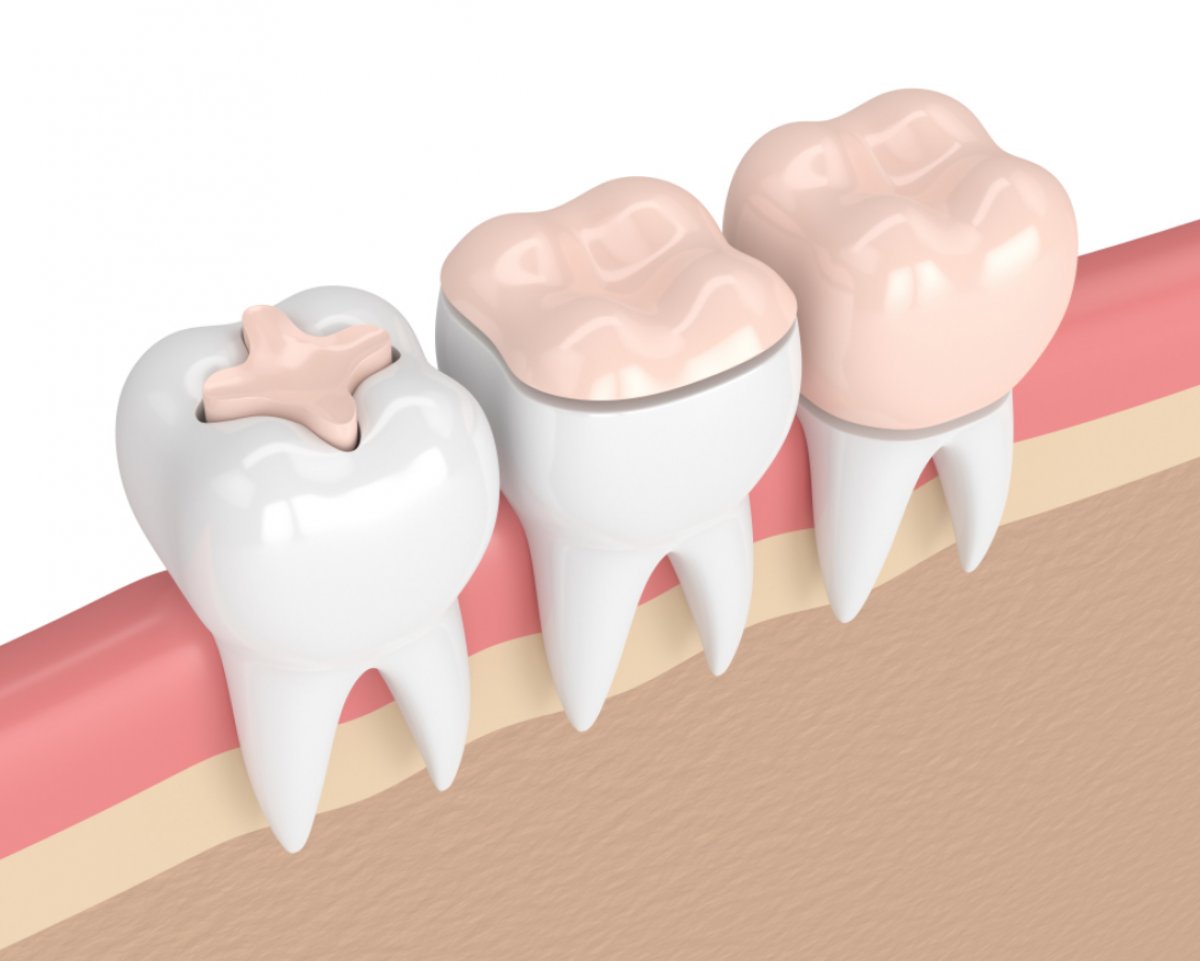
Inlays and onlays are porcelain or ceramic fillings used on teeth with large cavities or breaks; they are made outside the mouth to a measurement. The difference from a normal filling is that, instead of being shaped inside the tooth, they are prepared beforehand and bonded to the tooth. An inlay sits inside the hollow on the chewing surface of the tooth, while an onlay also covers the cusps of the tooth. Because they remove less tooth tissue than a crown, they are considered when most of the tooth is sound but too much of it is missing for a normal filling. The dentist decides which one is suitable after the examination.
What are inlays and onlays?
Inlays and onlays are pieces that dentistry calls “indirect restorations”, that is, pieces prepared outside the tooth and bonded on afterwards. They are also called porcelain inlay-onlay fillings; because the piece is specially prepared to a measurement, it rebuilds the lost tooth structure. The terminology is sometimes confusing: instead of “inley” and “onley”, in Turkish you will often also see the spelling “inlay” and “onlay”. It is the same thing; it is a difference in spelling.
- Inlay: It sits inside the loss on the chewing surface of the tooth; it does not touch the tooth cusps.
- Onlay: It covers the chewing surface and one or more cusps together.
- Overlay: A wider form of the onlay; it covers the whole chewing surface. There is no firm boundary between them, and the dentist names it according to the size of the damage.
Among Avrupadent’s services are porcelain inlay and onlay procedures. You can find the question summarising this subject on the site on the page about considering porcelain inlay/onlay pieces within restorative treatment.
What are porcelain inlay and onlay fillings?
A porcelain inlay or onlay filling is a ceramic piece produced in a laboratory from an impression or a digital scan after the decay has been cleaned out and the tooth has been suitably prepared, and it is attached to the tooth surface with a special adhesive. Because porcelain is close to the colour of the tooth, it looks aesthetic, its surface is smooth and it is resistant to wear. Its tendency to irritate the gum is low; so when the margins are made properly, the fit with the gum is good.
The materials used include types of porcelain and ceramic; which one is chosen is decided with the dentist according to the chewing load, the position of the tooth and aesthetic expectation. In molars at the back of the mouth durability is more decisive, and in the front area appearance is.
How are inlays and onlays different from a normal filling?
A normal filling is a material placed directly into the cavity after the decay has been cleaned, shaped in the mouth and hardened with light; an inlay or onlay, on the other hand, is a hard piece prepared outside the mouth. A normal filling is finished in a single appointment and is often enough for small and medium-sized losses. With large losses, however, its limits come up, such as the shrinkage of the filling material, gaps forming at the margins and resistance to the chewing load.
| Topic | Normal (composite) filling | Inlay / onlay |
|---|---|---|
| How it is prepared | Placed in the mouth, layer by layer | Prepared outside the mouth to a measurement, then bonded |
| Suitable loss | Small and medium-sized cavities | Large cavities, replacement of large old fillings, broken cusps |
| Number of appointments | Usually a single appointment | Usually two appointments |
| Material | Tooth-coloured composite | Porcelain or ceramic |
| Durability | May remain limited with large losses | High resistance to the chewing load |
| Work on the tooth tissue | Usually less | Controlled additional preparation is needed for the piece to seat |
| Repair | Usually easy to repair | Renewed if damaged |
This table is a general framework; even on the same tooth the dentist may choose a different method depending on where the damage is. We explained how a normal filling is done separately in the article what is a tooth filling and how is it done.
When is an inlay or onlay preferred?
An inlay or onlay is preferred when there is a large loss in the tooth and a normal filling is not expected to last long; but the rest of the tooth must be sound enough. In making this decision, the dentist looks at how much of the tooth the loss covers and the thickness of the remaining tooth walls.
An inlay or onlay is considered in the following situations:
- Wide cavities covering the chewing surface of molars
- Teeth in which old and wide fillings need to be replaced
- Broken or cracked tooth cusps
- When a tooth needs strengthening after root canal treatment, if the dentist sees fit
- Situations where aesthetics matter and a metal-free solution is wanted
For heavier damage, a crown that wraps the whole tooth may be needed. Among Avrupadent’s services are zirconia crowns and laminate veneers; the page on when aesthetic filling procedures are preferred helps you compare the different options. Where the problem comes from wear on the tooth surface, you can look at the article on how aesthetic restoration is planned for worn teeth.
Who are porcelain inlays and onlays suitable for?
They are suitable for people who need a large filling but whose tooth root and walls are largely sound. Better results are expected in people whose gum health is good, whose oral hygiene is adequate and whose chewing habits are under control. If there is teeth clenching and grinding, the dentist assesses it beforehand, because too much load increases the risk of the porcelain piece cracking.
Where very little of the tooth is left, or the root or gum has a problem, that problem is treated first; if necessary, root canal treatment or a different crown is planned. The examination and X-ray show suitability.
How many sessions does an inlay or onlay take?
Inlays and onlays are generally completed in two appointments: in the first, the decay is cleaned, the tooth is prepared, an impression or digital scan is taken and a temporary filling is placed; in the second, the prepared porcelain piece is tried in and bonded to the tooth. The time to prepare the piece varies with the laboratory process.
- Examination and planning: The tooth is examined with an X-ray and, if necessary, a tomography; whether an inlay or an onlay is needed is determined.
- Preparing the tooth: Under local anaesthesia the decay and old filling are cleaned out, and the edges of the tooth are shaped so that the piece will seat.
- Impression or scan: The impression of the prepared cavity is taken; intraoral scanning and impression techniques can be used.
- Temporary filling: The tooth is protected while the piece is being prepared.
- Try-in and bonding: The piece is placed on the tooth, its fit and bite balance are checked, and then it is bonded.
- Polishing and check: The margins are corrected, the surface is polished and the bite is checked again.
Because the tooth is prepared under local anaesthesia at the first appointment, the aim is that you do not feel pain during the procedure. Mild sensitivity can last a few days after bonding.
How is the preparation done?
Preparation is the shaping of the tooth so that it will take the porcelain piece, and it requires a more controlled preparation, following certain rules, than a normal filling. The decay is cleaned out completely, the margins are shaped with smooth, even lines, and the walls are left slightly open so that the piece can come out of the tooth easily. The margin form (for example a soft step or groove form) is chosen according to the type and material of the piece; the dentist plans this technical detail.
During preparation the aim is to preserve as much sound tooth tissue as possible. For this reason, inlays and onlays are seen as an option that can be worked with less tissue loss than a crown that covers the whole tooth.
How long do inlays and onlays last?
With the right indication, a good fit and regular care, inlays and onlays can be used for many years; however, it is not possible to give a single duration that applies to everyone. Besides the material, the lifespan is determined by the condition of the tooth, the chewing load, oral hygiene and habits. Although porcelain is resistant to wear, it can crack with a hard blow.
The main factors affecting lifespan are these:
- Fit of the piece: If the margins seat fully on the tooth, the risk of decay and leakage is reduced.
- The tooth underneath: If new decay starts under the piece, the inlay may need renewing even if it is sound.
- Teeth clenching and grinding: It puts constant extra load on the piece; a night guard may be needed.
- Biting hard objects: Biting ice, seed shells or pens can lead to cracks.
- Hygiene and check-ups: Regular brushing, dental floss and periodic examinations catch small problems early.
The difference between inlays/onlays and a crown
Inlays and onlays repair only the damaged part of the tooth, while a crown wraps the whole outer surface of the tooth. For this reason a crown requires more tooth tissue to be prepared; inlays and onlays allow sound tissue to be preserved. A crown is preferred if the walls of the tooth have become very thin, the tooth is broken, or the tooth needs strengthening after root canal treatment.
When choosing, the dentist looks at the following: the thickness of the remaining tooth walls, whether there is a crack, the chewing load on the tooth and your aesthetic expectation. The decision is not final; during the examination the plan can change after the decay is cleaned out, and an onlay or a crown may be needed instead of an inlay. Knowing this beforehand helps you set your expectation correctly.
Possible sensitivity and problems after the procedure
After the procedure, mild sensitivity to cold and heat lasting a few days may be seen; this is the usual reaction of the tooth to the preparation and bonding process and mostly eases by itself. If you notice a feeling of hardness when biting, a hairline at the edge of the piece or a rough spot your tongue catches on, the dentist can adjust the bite balance.
In the following cases you need to come without waiting for a check-up appointment: pain that continues or increases, the piece moving or falling out, a crack in the piece, swelling in the gum. Problems noticed early are mostly solved with a simple correction.
Inlays and onlays when replacing old fillings
If decay has developed under an old and large filling, or the margins of the filling are leaking, making an inlay or onlay in its place can be discussed as an option. The dentist removes the old filling, sees the condition of the tooth beneath and decides which restoration is suitable according to the remaining tissue. If the tooth is found to be weaker than expected when the filling is removed, the plan may change at that moment. For this reason, with large filling replacements it is useful to come to the first appointment with a flexible plan, and the possibilities are discussed with the dentist beforehand.
Care recommendations
After inlays and onlays are fitted, care is not very different from the care of your other teeth; but you need to take care around the margin. Brushing twice a day, dental floss or an interdental brush and, if needed, a mouthwash are the basic routine.
- For as long as the dentist recommends after the piece is bonded, stay away from very hard and sticky foods.
- When cleaning the edge of the tooth with dental floss, take care not to pull on the piece; slide the floss sideways to remove it.
- Tea, coffee and smoking can stain the tooth itself; the porcelain surface has a low tendency to hold stains, but the area around the margin can discolour.
- If you clench your teeth, ask your dentist about a night guard.
- If you notice sensitivity, a feeling of hardness when biting or movement in the piece, come without waiting.
Regular check-ups and scaling are also part of supporting the life of the piece. Among Avrupadent’s services is scaling as well.
Factors that affect the scope of treatment
What affects the plan for inlays and onlays depends on the condition of the tooth, how many teeth need treatment, the chosen material and any need for additional treatment. For example, active decay, a gum problem or the need for root canal treatment is added to the treatment plan. For this reason a detailed assessment is made after the examination and the dentist explains the plan to you.
To make the plan correctly, it helps to share with the dentist at the examination your previous X-rays, the medicines you use and the information about your current fillings.
Common mistakes and points to watch
Although inlays and onlays are successful, some wrong expectations can lead to disappointment. The following points help the process go well:
- Assuming every large filling is an inlay: If the walls of the tooth are very thin, a crown may be needed instead of an inlay.
- Neglecting the temporary filling: Between the first and second appointment the temporary filling protects the tooth; straining it with hard foods can make it fall out.
- Not coming for check-ups: If a small leak after bonding is not noticed, decay can develop underneath.
- Not mentioning teeth clenching: A habit not told to the dentist can cause the piece to crack early.
- Waiting out the sensitivity: Sensitivity that goes on for more than a few days after bonding, or a hard feeling when biting, should be reported to the dentist.
Appointment and examination
If you have a large filling, or your filled tooth often aches or breaks, the way to find out whether an inlay or onlay is suitable for you is an examination. Avrupadent’s branches are in the Çiğli, Balçova, Buca, Gaziemir and Konak districts of İzmir; patients also come from surrounding districts such as Bornova, Karabağlar, Güzelbahçe and Karşıyaka.
At the examination the tooth is examined, an X-ray is taken if necessary and the options are discussed with you. For your questions or an appointment, you can reach Avrupadent through the contact page.