What is the importance of gum health in aesthetic dental treatment?
Although restorative applications in the anatomy of the mouth and jaw often seem to focus on the color and shape arrangements of the teeth, the biological condition of the soft tissue surrounding these teeth (the gums) forms the essential basis that supports the visual and functional success of the outcome. The health of the boundaries where prosthetic materials such as porcelain laminates, zirconium crowns, or composite fillings are combined with gum tissue is one of the primary areas of focus in the field of Aesthetic Dentistry. Restorations placed over inflamed, swollen, or retracted gum tissue can exhibit compatibility issues within a short time, leading to a need for reassessment.
In dental terminology, the area formed by the teeth is referred to as white aesthetics, while the framework created by the gums is called pink aesthetics. The harmonious interaction between these two areas creates a balanced smile dynamics. As observed in the clinical processes at Avrupadent, prosthetic stages cannot proceed without securing the periodontal (gum) health of the patients.
What does the concept of pink aesthetics express in dentistry?
Can Prosthetic Procedures Begin While There Are Gum Diseases?
In the presence of periodontal inflammation (gingivitis), the tissues protrude beyond normal dimensions, becoming swollen and reddish, and tend to bleed. If the physician performs tooth trimming or takes measurements based on this swollen condition, the porcelain teeth produced in the laboratory will be shaped according to the swollen tissue. In the following weeks, when the patient’s gum heals and returns to normal dimensions (to a lower level), gaps will occur between the finish line of the porcelain and the gum.
These resulting gaps will lead to the appearance of unsightly dark lines and cause food remnants to accumulate in these spaces, paving the way for new decay. Therefore, it is crucial to clean the tartar, flatten the root surface, and complete necessary antibacterial procedures before proceeding with restorative work, to allow the tissue to settle into its final form.
| Gum Problem | Possible Effect on Prosthetic Treatment | Recommended Clinical Approach |
|---|---|---|
| Swelling and Inflammation (Gingivitis) | It can lead to misleading measurement limits. After healing, limits may remain exposed. | Initially, the gum’s tartar should be cleaned to allow the tissue to return to its original level. |
| Gum Recession | It causes porcelain teeth to appear much longer and asymmetrical. | In necessary cases, tissue grafting operations can be performed to equalize levels. |
| Excessive Bleeding | It weakens the holding resistance of the bonding cements to the tooth. | Temporary teeth are expected until inflammation is brought under control. |
How Do Unhealthy Gums Affect the Measurement Process?
The most critical step in transferring prosthetic procedures to the laboratory is accurately copying the margin (boundary) line where the tooth meets porcelain. In healthy gum tissues, this process is practically carried out using fine retraction cords. The cord gently separates the gum and allows for a flawless copying opportunity by wrapping the measuring material around the tooth’s circumference.
However, even slight contact with inflamed tissues can lead to an increase in tissue fluid and bleeding. This fluid prevents silicon measuring materials or digital optical scanners from clearly seeing the tooth surface. In order for restorations produced according to an unclear measuring model to have proper fitting on the tooth, it is expected that the gum remains free of bleeding and moisture during the measuring session.
How Does Gum Recession Affect the Appearance of Crowns?
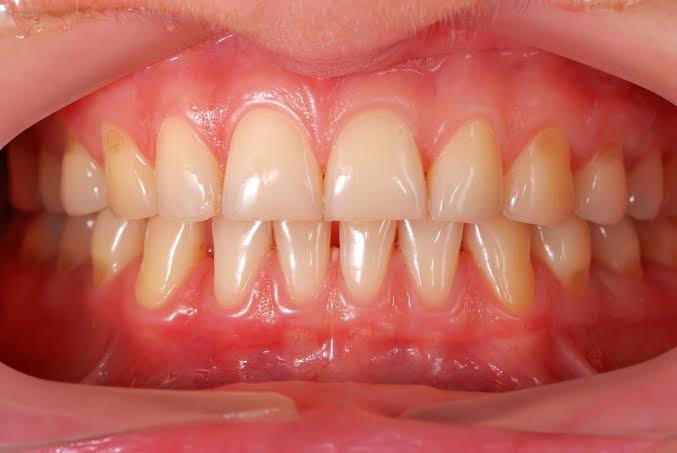
Advancing age, hard tooth brushing habits, or factors like periodontitis (advanced gum disease) can lead to gum retreating towards the root apex parallel to the resorption of the bone tissue. When there is a crown on the tooth, this recession process leaves the endpoint of the crown exposed.
The outer layer of the tooth, having a more yellowish tone compared to the enamel layer, creates a contrast with the whiteness of the porcelain. Additionally, the melting of the triangular gum tissue (papilla) between the teeth leads to the formation of dark spaces that cast shadows between the teeth (black triangle). To meet aesthetic expectations, regular brushing and interproximal maintenance are recommended to prevent these pullbacks.
Why is the Concept of Biological Width Considered in Restorations?
Biological width is a delicate area that exists in every individual with millimetric measurements and contains the connective tissue where the gum attaches to the bone and the epithelial attachment. If the boundary of the restoration is pushed too far down (toward the bone) during tooth trimming or composite filling placement, this natural barrier is violated.
The body perceives the violating restoration as a foreign object, triggering a continuous tissue reaction (chronic inflammation, bleeding, and bone resorption) in that area. In the planning of aesthetic dentistry, care is taken to carefully define tooth trimming boundaries to avoid such biological violations or, when necessary, to surgically rearrange the bone level (crown lengthening) to preserve the biological width.
In Which Situations is Laser-Assisted Gum Shaping Planned?
In some individuals, although the tooth sizes are anatomically within normal limits, the gums may cover the tooth surface excessively, causing the teeth to appear square and short. In the condition called gummy smile, when the lip rises, the pink tissue becomes very prominent.
To correct this aesthetic disproportionality, diode or erbium laser devices are used to gently remove the excess gum tissue. The use of lasers helps limit bleeding during tissue cutting, thus supporting the healing process. These small touches allow for elongation of the teeth before moving on to porcelain restorations, resulting in a more proportionate form.
How Does Gum Bleeding Affect the Cementation Stage?
The most sensitive chemical step in prosthetic dental treatments is the bonding of the caps coming from the laboratory. The current resin cements used work with acid-bond systems, and for this chemical bonding to occur, the tooth surface must be completely dry and free from all types of liquid (including saliva and blood).
Even a small drop of blood that can ooze from inflamed or irritated gums can disrupt the polymerization (hardening) bonds when it mixes with the surface the prosthetic adheres to. This situation can lead to displacement of the restoration in later stages or may initiate leakage from that space. Therefore, tissue health is a fundamental aspect that not only supports aesthetics but also the mechanical lifespan of the treatment.
How is Gum Evaluation Conducted in AVB Processes?
In the standards of medical services, aesthetic success is proportionate to the health of the foundation it is built upon. When patients come to the clinic with prosthetic expectations, periodontal mapping is primarily conducted by specialists. Possible bleeding from the gums, pocket depths, and bone levels are recorded.
In necessary cases, a preparatory phase (hygiene phase) is structured before planning Aesthetic Dentistry. Once the tissues achieve a pink, firm, and non-bleeding state, the main treatment can commence, which helps maintain aesthetic integrity over the years.
What Are Frequently Asked Questions?
1. Should tartar cleaning be done before starting aesthetic treatments?
Since tartar can lead to inflammation and volume changes in the tissues, it is recommended to perform cleaning before treatment to accurately determine the limits of the measurements.
2. Can a porcelain measurement be taken while there is bleeding in my gums?
Due to the difficulty of accurately reproducing the details of the measurement materials when there is bleeding and tissue fluid, it is deemed more appropriate to proceed to the measurement phase after the bleeding is controlled.
3. Does laser gum surgery (gingivectomy) affect daily activities?
Since laser applications provide bleeding control, tissue adaptation is generally rapid; patients can return to their daily functions in a short time.
4. Is a gummy smile corrected only through surgery?
Depending on the bone and tooth structure, the appearance of the gums can be reduced with laser-assisted minor interventions or sometimes supported by Botox applications.
5. Are zirconium crowns compatible with gums?
Zirconium is a material with high biological compatibility; since it contains no metal, it helps reduce the risk of purplish or gray discoloration along the gum margins.
6. Will not using dental floss after my crowns are made harm the tissues?
On the contrary, using dental floss helps to remove food accumulation around the edges of the crown, supporting the health and form of the gums.
7. What symptoms arise when the biological interval is violated?
Symptoms such as localized redness not extending beyond the gum margin, chronic bleeding, tissue sensitivity, and signs of bone level regression over time can be observed.
8. Does smoking affect pink aesthetics?
The use of tobacco can adversely affect the tissues by impairing the nutrition of the gums, leading to purplish discolorations (melanin pigmentation) and recessions, which can impact aesthetics.
9. Do the teeth underneath the crowns decay?
The crown itself does not decay, but if the gum line is not properly cleaned, the gum may recede and expose the tooth structure underneath to decay.
10. When can porcelain teeth be placed after gum shaping?
Depending on the healing speed of the tissue and the size of the sculpted area, it is generally preferred to wait a few weeks for the gum to adjust to its new shape.
11. Does receded gum tissue grow back?
Gum tissues do not naturally grow back to their old position; however, in some cases where necessary, tissue grafting can be performed to level the area.
12. Why is symmetry important in aesthetic dentistry?
The human eye perceives symmetry in the face as aesthetic and harmonious; it is important for both the heights of the teeth and the gum peaks to be balanced for this reason.
13. Do porcelain laminates harm the gums?
Laminates prepared in accordance with clinical guidelines and polished to be smooth are friendly materials for the gums and are not expected to cause a negative reaction on the tissue.
14. Do gum diseases affect the longevity of aesthetic treatments?
The weakening of supporting tissues can lead to tooth mobility or the exposure of crown margins, thereby directly affecting the long-term success of the treatment.
15. How is gum health monitored according to Avrupadent standards?
After the treatments, patients are invited for follow-up appointments at certain intervals, where gum compatibility and overall oral hygiene are assessed professionally.